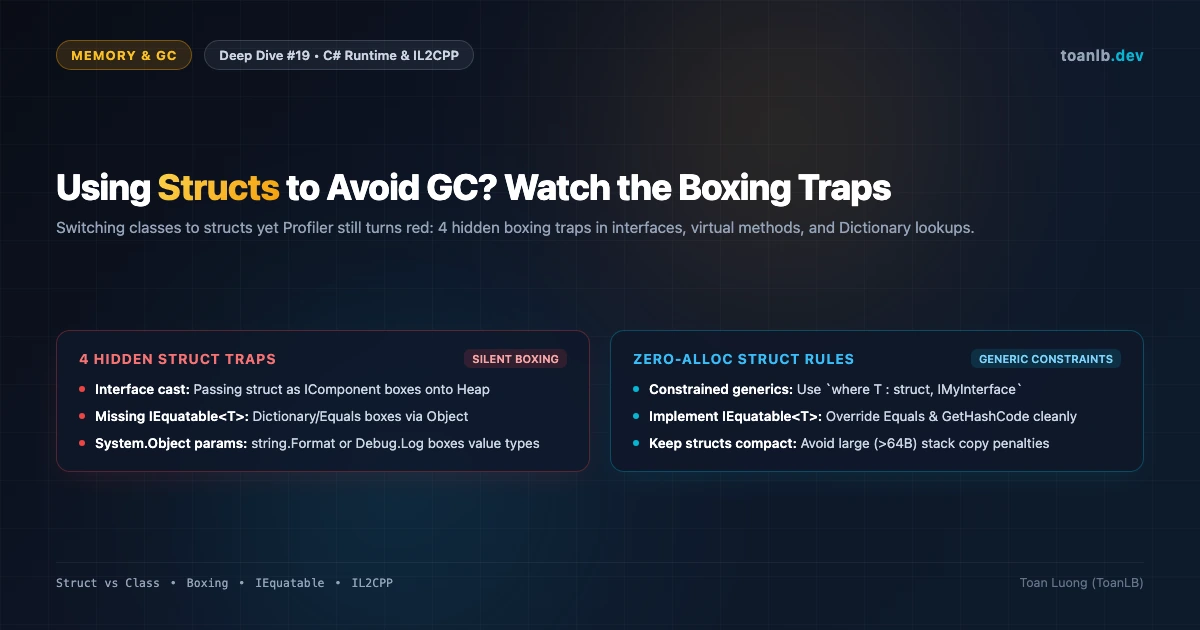
When optimizing mobile game performance to secure a rock-solid 60 FPS, many Unity developers lean into an intuitive rule of thumb: “Convert data models from classes to structs. Structs are value types allocated on the stack, ensuring zero garbage collection allocation.”
Yet after days of refactoring combat models, projectile telemetry, and character states into structs, opening the Unity Profiler reveals a frustrating reality: the GC Alloc column under Update continues ticking upward with tens of kilobytes per frame. Even worse, the overall frame rate stutters because the CPU gets choked copying memory buffers back and forth.
Why does this paradox happen? How does the C# CLR and Unity IL2CPP runtime handle structs under the hood? This article breaks down struct memory allocation mechanics, identifies four common hidden allocation traps, and examines the trade-off between pass-by-value CPU overhead and cache locality.
1. Deconstructing the Myth: Are Structs Always on the Stack?
One common misconception in C# development is conflating Value Type with always living on the Stack.
In the memory architecture of the .NET CLR and Unity IL2CPP, where a struct actually resides depends strictly on its declaration context and ownership:
flowchart TD
    subgraph S1["1. Local Method Variables"]
        L1["Local Struct<br/>(Update / Calculate Method)"] -->|"Direct allocation"| StackMem["Stack Memory<br/>(Popped upon scope exit)"]
    end

    subgraph S2["2. Fields inside Classes"]
        F1["Struct Field<br/>(Inside MonoBehaviour / Class)"] -->|"Embedded in object"| HeapMem1["Managed Heap<br/>(Shares parent class lifecycle)"]
    end

    subgraph S3["3. Contiguous Struct Arrays"]
        A1["MyStruct[] Array<br/>(Array is a reference type)"] -->|"Contiguous buffer"| HeapMem2["Managed Heap<br/>(Sequential memory alignment)"]
end- Local method variables: Allocated directly on the CPU stack. When execution leaves the method scope, the stack pointer decrements instantly without Garbage Collector intervention.
- Fields inside a Class or MonoBehaviour: Because the class itself is a reference type living on the managed heap, any struct fields declared within it are embedded directly inside that heap allocation.
- Elements in a
MyStruct[]array: In C#, arrays are reference types. Consequently, a struct array lives on the managed heap. The key architectural difference compared to class arrays is that struct elements sit contiguously in memory rather than as fragmented pointers scattered across the heap.
Structs do not automatically guarantee exemption from the managed heap. If handled incorrectly, they trigger boxing and allocate temporary objects on the heap.
2. Four Hidden Traps That Leak Allocations into the Profiler
Before exploring low-level mechanics, let us look at the four primary culprits that turn structs into hidden allocation sources:
flowchart LR
subgraph BoxingGroup["Heap Boxing Traps"]
T1["<b>1. Interface Casting</b><br/>• Passing struct to interface<br/>• Missing generic constraint"]
T2["<b>2. Missing IEquatable<T></b><br/>• Default ValueType.Equals<br/>• Reflection over fields"]
T3["<b>3. Dictionary Keys</b><br/>• Dictionary<MyStruct, T><br/>• EqualityComparer.Default fallback"]
end
subgraph ClosureGroup["Scope Capture Traps"]
T4["<b>4. Lambda Closures</b><br/>• Capturing struct in delegate<br/>• DisplayClass on Heap"]
end
BoxingGroup --> ClosureGroup3. Under the Hood: Dissecting the Four Traps
3.1. Trap 1: Boxing When Casting Structs to Interfaces or System.Object
Consider a combat system defining an interface ICombatReceiver and a struct TargetCombatState. When writing a damage application method that accepts an ICombatReceiver target parameter:
Passing a struct value type to an interface reference type forces the runtime to perform Boxing:
- It allocates a new object on the managed heap sized to fit the struct plus an object header (Method Table Pointer and Sync Block Index, consuming 16 bytes on 64-bit architectures).
- It copies the raw bytes of the struct from the stack onto that newly minted heap chunk.
- Invoking the interface method operates on the boxed heap clone, leaving the original stack instance untouched, triggering both GC garbage and state desynchronization bugs.
The Solution: Use a Generic Constraint such as where T : struct, ICombatReceiver. The compiler generates specialized machine code for struct type T, invoking the method directly without virtual table boxing, achieving zero bytes of GC allocation while mutating the target in-place.
3.2. Trap 2: Omitting Equals, GetHashCode, and IEquatable<T>
When comparing two structs using Equals() without custom overrides, the runtime falls back to System.ValueType.Equals.
Under the hood in the CLR/Mono runtime, System.ValueType.Equals inspects fields via Reflection to compare raw bytes. This reflection routine wastes CPU cycles and boxes the struct into System.Object, generating garbage every time a comparison occurs inside the game loop.
The Solution: Implement IEquatable<T>, override Equals(object), GetHashCode(), and implement the == and != operators. This directs calls directly to the strongly-typed method without boxing or reflection overhead.
3.3. Trap 3: Structs as Dictionary or HashSet Keys
Many caching and inventory systems use coordinate structs as dictionary keys: Dictionary<ItemCoord, InventorySlot>.
If ItemCoord fails to implement IEquatable<ItemCoord>, the dictionary falls back to EqualityComparer<ItemCoord>.Default. This default comparer treats unspecialized structs with ValueType.Equals and ValueType.GetHashCode.
Every single call to TryGetValue() or ContainsKey() inside Update causes boxing allocations just to compute the hash code and evaluate equality.
The Solution: Always implement IEquatable<T> on key structs, or pass a dedicated IEqualityComparer<T> into the dictionary constructor.
3.4. Trap 4: Capturing Structs in Lambda Closures
A common trap occurs when attaching structs to event listeners or callbacks.
When a local value type is captured by an anonymous delegate or lambda expression, the C# compiler generates an internal Display Class on the managed heap. The struct is copied into a field on that heap object, accumulating garbage every time listeners are registered during gameplay.
4. When Structs Degrade Performance: Pass-By-Value and Defensive Copies
Developers often focus on memory allocation while overlooking that Structs are passed by value.
Passing a struct into a method or assigning it to another variable copies its entire memory footprint:
flowchart LR
    subgraph SmallStruct["Small Struct (16 bytes)"]
        S1["Vector3 (12 bytes)<br/>X, Y, Z"] -->|"Register copy"| CPU1["Fast CPU Registers<br/>~1 cycle cost"]
    end

    subgraph BigStruct["Big Struct (128 bytes)"]
        B1["CombatPacket (128 bytes)<br/>16 state fields"] -->|"Stack memcpy"| CPU2["Stack Memory Copy<br/>L1 Cache Bottleneck"]
    end
The 16-Byte Threshold
- Small structs (16 bytes or smaller): Types like
Vector2,Vector3,Quaternion, or two 64-bit integers. Modern CPUs load these cleanly into registers, copying them in one or two cycles. Here, structs outperform classes by eliminating pointer indirection. - Large structs (over 32 to 64 bytes): Structs packing multiple combat attributes (health, armor, resistance, critical chance, move speed, flags). Every method call executes a full memory copy on the stack. In a hot update loop with hundreds of active entities, this copy overhead saturates CPU cache lines. By comparison, classes only copy an 8-byte reference pointer.
The Defensive Copy Trap of the in Keyword
To circumvent large copy overhead, C# 7.2 introduced the in modifier for read-only pass-by-reference.
However, if the struct is not marked as readonly struct, the compiler cannot guarantee that invoked methods do not mutate internal state.
To preserve immutability guarantees, the compiler silently creates a defensive copy of the struct on the stack before executing member methods. You write in to prevent copies, yet the compiler introduces hidden copies anyway.
The Solution: Always pair in parameters with readonly struct. This informs the compiler that the struct is immutable, eliminating defensive copying completely.
5. The True Strength of Structs: Cache Locality and Data-Oriented Design
When do structs decisively outperform classes? The primary advantage lies in Contiguous Memory Alignment and CPU Cache Locality:
flowchart TD
    subgraph ClassArray["MyClass[]: Pointer Chasing (Fragmented)"]
        CA["Pointer Array [Heap]"] --> P1["Object 1 [Heap Address 0x1A00]"]
        CA --> P2["Object 2 [Heap Address 0x8F40]"]
        CA --> P3["Object 3 [Heap Address 0x3C10]"]
    end

    subgraph StructArray["MyStruct[]: Contiguous Alignment"]
        SA["Flat Memory [Heap]: [Struct 0][Struct 1][Struct 2][Struct 3]"]
        SA -->|"Loads full 64B Cache Line"| L1["Maximized L1/L2 CPU Cache Hits"]
endMyClass[]Arrays: The array stores pointers pointing to arbitrary heap addresses. Iterating through the array causes Pointer Chasing, resulting in frequent cache misses that stall CPU pipelines while fetching from slower main RAM.MyStruct[]Arrays: All struct instances sit sequentially in a flat memory buffer. When the CPU accesses the first element, hardware prefetchers load the entire 64-byte cache line containing subsequent elements into L1/L2 cache, yielding three- to ten-fold throughput gains. This contiguous layout forms the core foundation of Unity ECS and DOTS.
6. Implementation: From Allocation Traps to Zero-Alloc Architecture
The following real-world combat scenario illustrates how to structure structs and processing pipelines to achieve zero bytes of heap allocation.
6.1. Defining Structs and Interfaces
using System;
using UnityEngine;

public interface ICombatReceiver
{
    int CurrentHp { get; }
    void ReceiveDamage(int amount);
}

// 1. readonly struct eliminates defensive copies when passed with 'in'
// 2. IEquatable<T> eliminates reflection and boxing during equality checks and dictionary lookups
public readonly struct CombatHitData : IEquatable<CombatHitData>
{
    public readonly int HitId;
    public readonly int AttackerId;
    public readonly int BaseDamage;
    public readonly float CritMultiplier;
    public readonly Vector3 HitPoint;

    public CombatHitData(int hitId, int attackerId, int baseDamage, float critMultiplier, Vector3 hitPoint)
    {
        HitId = hitId;
        AttackerId = attackerId;
        BaseDamage = baseDamage;
        CritMultiplier = critMultiplier;
        HitPoint = hitPoint;
    }

    public int CalculateFinalDamage()
    {
        return Mathf.RoundToInt(BaseDamage * Mathf.Max(1f, CritMultiplier));
    }

    public bool Equals(CombatHitData other)
    {
        return HitId == other.HitId &&
               AttackerId == other.AttackerId &&
               BaseDamage == other.BaseDamage &&
               Mathf.Approximately(CritMultiplier, other.CritMultiplier) &&
               HitPoint == other.HitPoint;
    }

    public override bool Equals(object obj)
    {
        return obj is CombatHitData other && Equals(other);
    }

    public override int GetHashCode()
    {
        return HashCode.Combine(HitId, AttackerId, BaseDamage, CritMultiplier, HitPoint);
    }

    public static bool operator ==(CombatHitData left, CombatHitData right) => left.Equals(right);
    public static bool operator !=(CombatHitData left, CombatHitData right) => !left.Equals(right);
}

public struct TargetCombatState : ICombatReceiver
{
    public int CurrentHp { get; private set; }

    public TargetCombatState(int initialHp)
    {
        CurrentHp = initialHp;
    }

    public void ReceiveDamage(int amount)
    {
        CurrentHp = Mathf.Max(0, CurrentHp - amount);
    }
}
6.2. Zero-Alloc Combat Processor
public static class ZeroAllocCombatEngine
{
    // Generic constraint 'where T : struct, ICombatReceiver' avoids interface boxing
    // Parameter 'in CombatHitData hit' passes by read-only reference without copying the full struct
    public static int ExecuteHit<T>(ref T receiver, in CombatHitData hit) where T : struct, ICombatReceiver
    {
        int finalDamage = hit.CalculateFinalDamage();
        receiver.ReceiveDamage(finalDamage);
        return finalDamage;
    }
}
6.3. Automated NUnit Verification Tests
using System;
using System.Collections.Generic;
using NUnit.Framework;
using UnityEngine;

[TestFixture]
public class StructAllocationTests
{
    [Test]
    public void ExecuteHit_ModifiesTargetHp_Accurately()
    {
        var target = new TargetCombatState(100);
        var hit = new CombatHitData(1, 10, 30, 1.5f, Vector3.zero);

        int damageDealt = ZeroAllocCombatEngine.ExecuteHit(ref target, in hit);

        Assert.AreEqual(45, damageDealt);
        Assert.AreEqual(55, target.CurrentHp);
    }

    [Test]
    public void ExecuteHit_WithGenericConstraint_AllocatesZeroBytesOnManagedHeap()
    {
        var target = new TargetCombatState(200);
        var hit = new CombatHitData(2, 10, 20, 1.0f, Vector3.up);

        // Warm up JIT execution
        ZeroAllocCombatEngine.ExecuteHit(ref target, in hit);

        long beforeAlloc = GC.GetAllocatedBytesForCurrentThread();
        ZeroAllocCombatEngine.ExecuteHit(ref target, in hit);
        long afterAlloc = GC.GetAllocatedBytesForCurrentThread();

        Assert.AreEqual(0, afterAlloc - beforeAlloc, "ExecuteHit with generic constraints must allocate exactly zero heap bytes.");
    }

    [Test]
    public void CombatHitData_IEquatable_PreventsBoxingAndEnsuresCorrectEquality()
    {
        var hitA = new CombatHitData(1, 10, 50, 1.2f, new Vector3(1, 2, 3));
        var hitB = new CombatHitData(1, 10, 50, 1.2f, new Vector3(1, 2, 3));
        var hitC = new CombatHitData(2, 10, 50, 1.2f, new Vector3(1, 2, 3));

        Assert.IsTrue(hitA == hitB);
        Assert.IsTrue(hitA.Equals(hitB));
        Assert.IsFalse(hitA == hitC);
        Assert.AreEqual(hitA.GetHashCode(), hitB.GetHashCode());
    }

    [Test]
    public void DictionaryKey_WithIEquatableStruct_AllocatesZeroBytesOnLookup()
    {
        var hitDict = new Dictionary<CombatHitData, int>();
        var hit = new CombatHitData(99, 101, 100, 2.0f, Vector3.zero);
        hitDict[hit] = 1;

        // Warm up JIT execution
        hitDict.TryGetValue(hit, out _);

        long beforeAlloc = GC.GetAllocatedBytesForCurrentThread();
        bool found = hitDict.TryGetValue(hit, out int value);
        long afterAlloc = GC.GetAllocatedBytesForCurrentThread();

        Assert.IsTrue(found);
        Assert.AreEqual(1, value);
        Assert.AreEqual(0, afterAlloc - beforeAlloc, "Dictionary lookup with IEquatable struct keys must generate zero GC allocations.");
    }
}
7. Trade-Off Analysis: Struct vs Class
Selecting between structs and classes involves balancing distinct architectural trade-offs:
| Criterion | Struct (Value Type) | Class (Reference Type) |
|---|---|---|
| Default Allocation | Stack (when local) or embedded in container | Always on Managed Heap |
| Garbage Collection Cost | Zero if boxing is avoided | Generates GC pressure under repeated allocations |
| Assignment & Passing | Pass-by-value (copies entire memory buffer) | Pass-by-reference (copies 8-byte pointer) |
| Optimal Size | Small, ideally 16 bytes or smaller | Flexible, suited for complex entities |
| Passing Large Instances | Requires in with readonly struct | Standard reference passing |
| Array Memory Alignment | Contiguous buffer with high cache hit rate | Pointer chasing with frequent cache misses |
| Polymorphism & Hierarchy | No inheritance; polymorphism via generics | Supports virtual methods and class hierarchies |
| Potential Risks | Hidden boxing and mutating unintended copies | NullReferenceExceptions and reference leaks |
8. Practical Takeaways
To leverage structs effectively without inadvertently saturating the Profiler with garbage:
- Avoid treating structs as a magic bullet: Reserve structs for small, short-lived data containers (ideally
<= 16 bytes), or large contiguous arrays designed for cache locality. - Enforce generic constraints on interfaces: Always write
where T : struct, IMyInterfacewhen invoking interface methods on struct instances to prevent boxing. - Always implement
IEquatable<T>: ImplementIEquatable<T>and overload==and!=to eliminate reflection calls withinSystem.ValueType.Equals. - Mark large structs as
readonly struct: If a struct exceeds 16 bytes and must be passed using theinkeyword, mark itreadonly structto prevent defensive copies on the stack. - Verify with the Profiler: Validate allocations using the Unity Profiler and memory profiler to confirm that the
GC Allocmetric remains at zero bytes across release builds.