As a Unity project transitions from an early gameplay prototype into a full commercial release with intersecting systems (Inventory, Quests, Character Progression, Settings, and IAP History), engineering teams confront a foundational architectural crossroads:
Should each subsystem independently serialize and persist its own dedicated save file, or should all game state be unified under a single centralized SaveManager?
Both instinctive approaches carry technical hazards. Choosing the wrong strategy risks not only team-wide Git merge conflicts on shared data models, but also data split-brain corruptions that permanently delete player items when games crash mid-save.
Two Architectural Extremes and Their Pitfalls
In commercial production, persistence design often polarizes toward two extremes:
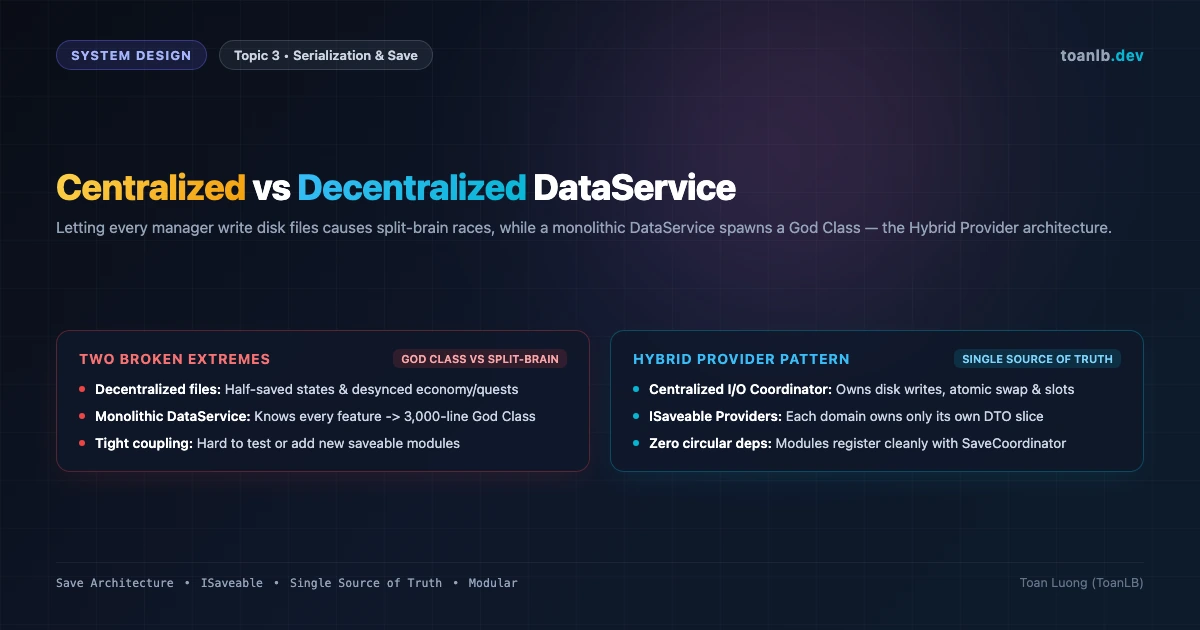
Extreme 1: Decentralized Saves and the Split-Brain Trap
The intuitive path of least resistance is allowing each feature to manage its own persistence: InventorySystem writes inventory.json, CurrencySystem writes currency.dat, and volume settings go to PlayerPrefs.
While this provides immediate module autonomy without cross-team dependencies, it introduces a severe data integrity vulnerability:
Consider a common in-game shop transaction: A player spends 5,000 Gold to purchase an Epic Sword.
CurrencySystemsubtracts 5,000 Gold and successfully flushescurrency.datto storage.- In the exact fraction of a second before
InventorySystemcan openinventory.jsonto append the sword, the mobile device runs out of battery, or the operating system terminates the app due to background memory pressure.
When the player launches the game again, their 5,000 Gold is gone, but the sword was never recorded. This is a classic Split-Brain Data Desynchronization defect. It is notoriously difficult to reproduce in editor play mode because it hinges on operating system disk scheduling and unexpected power cuts. Furthermore, multiple systems concurrently opening and locking separate file handles during autosaves degrades flash memory performance and causes micro-stutter.
Extreme 2: The Monolithic “God Object” Trap
Recognizing the hazards of decentralized I/O, projects frequently overcompensate by swinging to the opposite extreme: Constructing a single gargantuan GameSaveData class containing public fields for every system in the project, managed by a monolithic SaveManager.
This approach enforces atomicity: The entire game state is serialized in a single transaction. Either everything saves, or nothing saves. However, the architectural penalty is steep:
GameSaveDatadegenerates into a dumping ground that breaks encapsulation.SaveManageris tightly coupled to every gameplay namespace in the repository.- Every engineer modifying a minor quest objective or character stat must modify
GameSaveData. In a team of 5 to 10 developers, Git merge conflicts become a daily bottleneck.
flowchart LR
    subgraph DataProviders["Distributed Data Providers (Business Logic)"]
        A["Inventory System"]
        B["Currency System"]
        C["Quest System"]
    end

    O["Central Save Orchestrator"]

    subgraph StorageInfra["Centralized Storage Infrastructure"]
        D["Root Save Snapshot"]
        E["Single Save File (save.dat)"]
        D -->|"2. Off-thread Compression"| E
    end

    A -->|"1. CaptureState()"| O
    B -->|"1. CaptureState()"| O
    C -->|"1. CaptureState()"| O
    O -->|"2. Assemble Envelope"| D

    E -.->|"Load & Dispatch"| O
    O -.->|"RestoreState()"| A
    O -.->|"RestoreState()"| B
    O -.->|"RestoreState()"| C
The Hybrid Architecture: Centralized Infrastructure, Distributed Providers
To achieve high data integrity without sacrificing code modularity, we cleanly separate two core responsibilities:
1. Distributed Schema Ownership (Business Domain)
Each individual subsystem must retain strict encapsulation over its own state schema without leaking internal implementation details.
Every participating system implements a decoupled contract named ISaveable:
string SaveKey { get; }: A unique string identifier within the save payload (e.g.,"inventory","currencies","quests").JToken CaptureState(): Serializes internal state into an isolated JSON DOM token (JToken).void RestoreState(JToken state): Receives its dedicated token to rehydrate runtime state.
2. Centralized Storage Infrastructure (Platform & Lifecycle)
A central CentralSaveService acts as an infrastructure orchestrator:
- Maintains a registry of active
ISaveableproviders. - When saving triggers (Autosave, scene transitions, app pause),
CentralSaveServiceiterates over registered providers on the Main Thread, collectingJTokenstructures into aDictionary<string, JToken>root envelope. - Dispatches the entire envelope to a background worker to handle serialization, compression, and atomic file replacement (
File.Replace). - The orchestrator has zero knowledge of sword attributes or quest nodes; it operates entirely on abstract
JTokenpayloads.
Because the entire game state is serialized into a single atomic payload on disk, split-brain corruption is impossible. If the game crashes, the atomic write ensures the player either keeps their gold or receives both the gold deduction and the sword. Concurrently, gameplay engineers can freely refactor internal schemas without touching the persistence orchestrator or conflicting with teammates.
Production C# Implementation: Save Orchestrator and ISaveable Providers
The following C# implementation demonstrates the hybrid architecture using Newtonsoft.Json.Linq and automated NUnit test suites.
ISaveable Contract and Root Envelope
We declare ISaveable to decouple subsystems from the orchestrator, and RootSaveSnapshot as the unified envelope container.
using System;
using System.Collections.Generic;
using System.IO;
using System.Threading.Tasks;
using Newtonsoft.Json;
using Newtonsoft.Json.Linq;
using NUnit.Framework;

// Contract for subsystems requiring persistent state
public interface ISaveable
{
    string SaveKey { get; }
    JToken CaptureState();
    void RestoreState(JToken state);
}

// Unified root snapshot envelope holding all subsystem payloads
public class RootSaveSnapshot
{
    public int SchemaVersion { get; set; } = 1;
    public long SavedTimestamp { get; set; }
    public Dictionary<string, JToken> SystemStates { get; set; } = new Dictionary<string, JToken>();
}
Implementing CentralSaveService Orchestrator
The CentralSaveService coordinates provider registrations, snapshot gathering on the Main Thread, asynchronous disk writes, and state distribution upon loading.
public class CentralSaveService
{
    private readonly Dictionary<string, ISaveable> _registeredSaveables = new Dictionary<string, ISaveable>();

    public void Register(ISaveable saveable)
    {
        if (saveable == null) throw new ArgumentNullException(nameof(saveable));
        if (_registeredSaveables.ContainsKey(saveable.SaveKey))
        {
            throw new InvalidOperationException($"SaveKey '{saveable.SaveKey}' is already registered in SaveService.");
        }
        _registeredSaveables[saveable.SaveKey] = saveable;
    }

    public void Unregister(ISaveable saveable)
    {
        if (saveable != null && _registeredSaveables.ContainsKey(saveable.SaveKey))
        {
            _registeredSaveables.Remove(saveable.SaveKey);
        }
    }

    // Capture state across all registered providers into a single root snapshot
    public RootSaveSnapshot CaptureAllStates()
    {
        var snapshot = new RootSaveSnapshot
        {
            SavedTimestamp = DateTimeOffset.UtcNow.ToUnixTimeSeconds()
        };

        foreach (var pair in _registeredSaveables)
        {
            var token = pair.Value.CaptureState();
            if (token != null)
            {
                snapshot.SystemStates[pair.Key] = token;
            }
        }

        return snapshot;
    }

    // Persist snapshot to disk with atomic replacement
    public async Task SaveToDiskAsync(string filePath)
    {
        var snapshot = CaptureAllStates();
        string tempPath = filePath + ".tmp";

        await Task.Run(async () =>
        {
            string json = JsonConvert.SerializeObject(snapshot, Formatting.Indented);
            using (var writer = new StreamWriter(tempPath, append: false))
            {
                await writer.WriteAsync(json);
                await writer.FlushAsync();
            }

            if (File.Exists(filePath))
            {
                File.Replace(tempPath, filePath, filePath + ".bak");
            }
            else
            {
                File.Move(tempPath, filePath);
            }
        });
    }

    // Read payload from disk and dispatch dedicated JTokens to providers
    public async Task LoadFromDiskAsync(string filePath)
    {
        if (!File.Exists(filePath))
        {
            throw new FileNotFoundException("Save file not found.", filePath);
        }

        RootSaveSnapshot snapshot = null;
        await Task.Run(async () =>
        {
            using (var reader = new StreamReader(filePath))
            {
                string json = await reader.ReadToEndAsync();
                snapshot = JsonConvert.DeserializeObject<RootSaveSnapshot>(json);
            }
        });

        if (snapshot == null) return;

        foreach (var pair in _registeredSaveables)
        {
            if (snapshot.SystemStates.TryGetValue(pair.Key, out var token))
            {
                pair.Value.RestoreState(token);
            }
        }
    }
}
Implementing Concrete Subsystems: Currency and Inventory
The CurrencySubsystem and InventorySubsystem define and serialize their own schemas independently without exposing models to CentralSaveService.
// Concrete Subsystem 1: Currency Management
public class CurrencySubsystem : ISaveable
{
    public string SaveKey => "currencies";

    public int Gold { get; set; }
    public int Gems { get; set; }

    public JToken CaptureState()
    {
        return JObject.FromObject(new { Gold, Gems });
    }

    public void RestoreState(JToken state)
    {
        if (state is JObject obj)
        {
            Gold = obj["Gold"]?.Value<int>() ?? 0;
            Gems = obj["Gems"]?.Value<int>() ?? 0;
        }
    }
}

// Concrete Subsystem 2: Inventory Management
public class InventorySubsystem : ISaveable
{
    public string SaveKey => "inventory";

    public List<string> ItemIds { get; } = new List<string>();

    public JToken CaptureState()
    {
        return JArray.FromObject(ItemIds);
    }

    public void RestoreState(JToken state)
    {
        ItemIds.Clear();
        if (state is JArray arr)
        {
            foreach (var item in arr)
            {
                ItemIds.Add(item.Value<string>());
            }
        }
    }
}
NUnit Regression Test Suite
The test suite validates multi-provider synchronization, atomic file consistency, duplicate key guards, and missing state fallbacks.
[TestFixture]
public class CentralSaveServiceTests
{
    private string _testDir;
    private CentralSaveService _saveService;

    [SetUp]
    public void SetUp()
    {
        _testDir = Path.Combine(Path.GetTempPath(), "SaveServiceTest_" + Guid.NewGuid().ToString("N"));
        Directory.CreateDirectory(_testDir);
        _saveService = new CentralSaveService();
    }

    [TearDown]
    public void TearDown()
    {
        if (Directory.Exists(_testDir))
        {
            Directory.Delete(_testDir, recursive: true);
        }
    }

    [Test]
    public async Task SaveAndLoad_MultipleSubsystems_RestoresCoherentState()
    {
        string savePath = Path.Combine(_testDir, "gamesave.json");

        var currencySystem = new CurrencySubsystem { Gold = 15000, Gems = 50 };
        var inventorySystem = new InventorySubsystem();
        inventorySystem.ItemIds.AddRange(new[] { "sword_epic", "shield_iron", "potion_hp" });

        _saveService.Register(currencySystem);
        _saveService.Register(inventorySystem);

        // Save state atomically
        await _saveService.SaveToDiskAsync(savePath);
        Assert.IsTrue(File.Exists(savePath));

        // Create new instances simulating game restart
        var newCurrencySystem = new CurrencySubsystem();
        var newInventorySystem = new InventorySubsystem();
        var newSaveService = new CentralSaveService();

        newSaveService.Register(newCurrencySystem);
        newSaveService.Register(newInventorySystem);

        await newSaveService.LoadFromDiskAsync(savePath);

        // Verify accurate restoration across both domains
        Assert.AreEqual(15000, newCurrencySystem.Gold);
        Assert.AreEqual(50, newCurrencySystem.Gems);
        Assert.AreEqual(3, newInventorySystem.ItemIds.Count);
        Assert.AreEqual("sword_epic", newInventorySystem.ItemIds[0]);
    }

    [Test]
    public void Register_DuplicateKey_ThrowsInvalidOperationException()
    {
        var sys1 = new CurrencySubsystem();
        var sys2 = new CurrencySubsystem();

        _saveService.Register(sys1);
        Assert.Throws<InvalidOperationException>(() =>
        {
            _saveService.Register(sys2);
        });
    }

    [Test]
    public async Task MissingSystemStateInFile_LeavesSubsystemWithDefaultValues()
    {
        string savePath = Path.Combine(_testDir, "partial_save.json");

        // Save only currency state
        var currencySystem = new CurrencySubsystem { Gold = 500, Gems = 10 };
        _saveService.Register(currencySystem);
        await _saveService.SaveToDiskAsync(savePath);

        // Upon loading, register newly implemented inventory system
        var newSaveService = new CentralSaveService();
        var newCurrency = new CurrencySubsystem();
        var newInventory = new InventorySubsystem(); // Absent from historical save

        newSaveService.Register(newCurrency);
        newSaveService.Register(newInventory);

        await newSaveService.LoadFromDiskAsync(savePath);

        Assert.AreEqual(500, newCurrency.Gold);
        Assert.AreEqual(0, newInventory.ItemIds.Count, "New subsystem must retain safe defaults without throwing exceptions.");
    }
}
Architectural Trade-off Comparison
| Criteria | Decentralized File-per-System | Monolithic God Object SaveManager | Hybrid Orchestrator + ISaveable Providers |
|---|---|---|---|
| Data Integrity | High risk: prone to split-brain desynchronization during crashes. | Guaranteed: entire state serialized in a single transaction. | Guaranteed: root snapshot guarantees atomic single-file consistency. |
| Module Autonomy | High: systems operate completely blind to each other. | Extremely poor: save manager tightly couples to all domain models. | High: subsystems retain strict encapsulation via ISaveable. |
| Team Workflow | Good: minimal Git conflicts across feature branches. | Terrible: constant merge conflicts on monolithic save classes. | Excellent: developers only touch their respective subsystem DTOs. |
| Infrastructure Scalability | Fragmented: difficult to manage unified cloud saves or compression. | Fragile: simple initially, but degrades into technical debt. | Professional: disk I/O, compression, and cloud sync reside in one place. |
| Best Fit | Isolated prototypes or independent audio preferences. | Game Jam projects built in 48 hours by a single developer. | Commercial live-ops titles, multi-member engineering teams. |
Key Production Takeaways for Save Architecture
When architecting long-term persistence in Unity games:
- Centralize infrastructure, not business schemas: Keep file streams, compression, encryption, and cloud synchronization inside a unified
CentralSaveService. - Decouple domain schemas with contracts: Let subsystems own their persistent representations through contracts like
ISaveable. - Use intermediate JSON tokens: Employing
JTokenas an interchange currency keeps infrastructure classes pristine, preventing them from importing concrete gameplay domains.