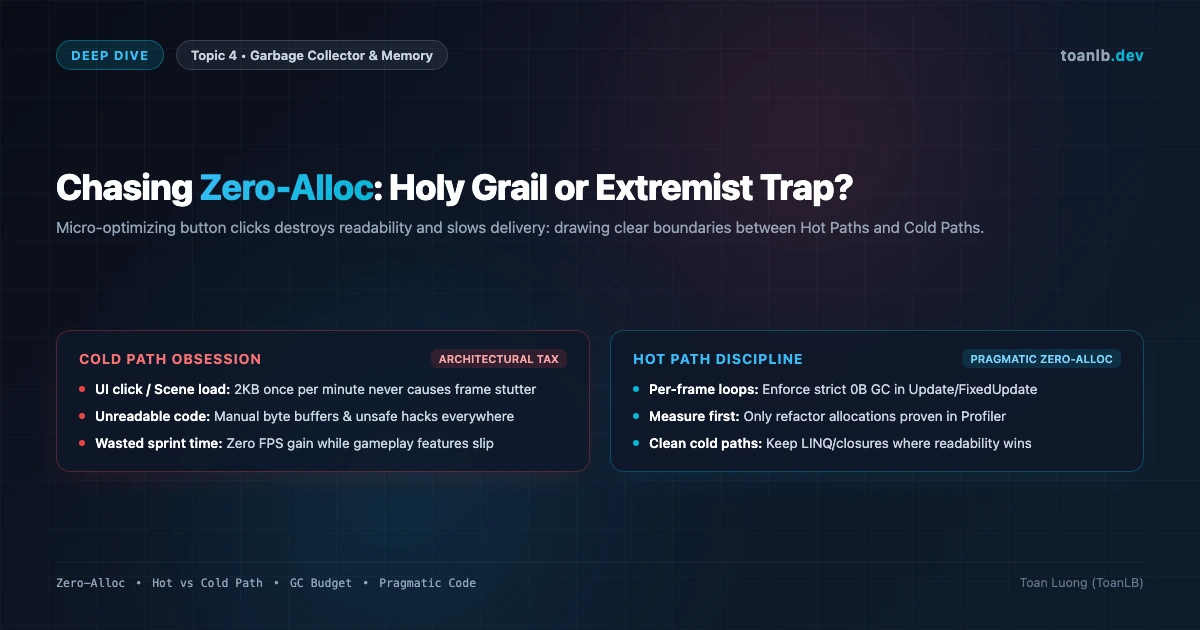
Almost every Unity engineer diving deep into garbage collection and runtime performance experiences a distinct phase of engineering mindset: Dogmatic Zero-Allocation.
Connecting a physical test device, opening the Unity Profiler, and seeing the GC Alloc column read exactly 0 B delivers an intoxicating sense of mastery. From that breakthrough, an unyielding conviction often takes root: truly high-grade Unity development demands the total eradication of heap allocations across every line of code, regardless of where that code executes.
Many teams gradually elevate Zero-Alloc into an inflexible dogma: banning LINQ across the entire repository, forbidding lambda closures, prohibiting string formatting even for single-shot UI labels, and mandating that every system - from settings dialogs and quit confirmations to inventory sorting and JSON parsing - must rely on custom object pools, pre-allocated static buffers, and pointer-driven structs.
Yet after several months of enforcing this zero-alloc orthodoxy, production reality strikes back: the codebase degenerates into a labyrinth of unreadable boilerplate, feature development velocity drops by half, state pollution bugs proliferate, and the project faces acute deadline pressure.
Is Zero-Allocation truly the universal holy grail of Unity development, or has it become an intellectual trap of premature optimization? Where lies the pragmatic engineering boundary between maintaining flawless 60 FPS performance and preserving codebase maintainability?
The Critical Boundary: Hot Path vs Cold Path
The primary fallacy of dogmatic zero-allocation is treating every line of game code as having equal performance impact. In modern game architecture, execution logic is split across two fundamentally different operational domains:
flowchart LR
    subgraph HOT["1. Hot Path (High-Frequency Loop)"]
        direction TB
        H1["Update, FixedUpdate, Render Loop"]
        H2["Executes 60 - 120 times per second"]
        H3["MANDATORY: Strict Zero-Alloc"]
        H1 --> H2 --> H3
    end

    subgraph COLD["2. Cold Path (Low-Frequency Events)"]
        direction TB
        C1["Startup, Scene Change, UI Popups"]
        C2["Fires once or every few minutes"]
        C3["PRIORITY: Clean & Readable Code"]
        C1 --> C2 --> C3
    end

    subgraph OUTCOME["3. Production Outcomes"]
        direction TB
        O1["Smooth 60 FPS without hitches"]
        O2["Maintainable codebase on schedule"]
        O1 --- O2
    end

    H3 -->|"Sustains Frame Budget"| O1
    C3 -->|"Preserves Velocity"| O2
1. Hot Path: Where Strict Zero-Alloc is Vital
The Hot Path comprises code executed continuously within the main game loop: Update(), FixedUpdate(), LateUpdate(), physics simulation steps, collision sweeps, and per-frame Canvas UI drawing routines.
These routines run 60 to 120 times every single second. On the Hot Path, zero-allocation discipline is mandatory and non-negotiable. Allocating just a few dozen bytes per frame inside an entity loop multiplies across hundreds of active units into megabytes of garbage within seconds. This repeatedly triggers Boehm GC sweep cycles, freezing the Main Thread and blowing past the 16.6ms frame budget required for 60 FPS.
2. Cold Path: Where Code Clarity Outweighs Byte Counting
The Cold Path encompasses low-frequency execution triggers:
- Initial startup sequence (
Awake, loading baseline configurations). - Scene transitions and level loading workflows.
- User-driven actions: opening Settings, reading in-game mail, or confirming dialogue prompts.
- Inventory sorting triggered exclusively on button clicks.
These operations run once per session or once every several minutes. In the Cold Path, forcing zero-allocation is an expensive waste of engineering velocity.
An inventory dialog allocating 2KB of transient string or LINQ data when opened cannot cause frame stutter, because it executes once and halts. That transient 2KB allocation is safely cleaned during engine idle time without any noticeable impact on player experience.
Case Study: If an API Allocates 20 Bytes per Frame, Should You Fix It Immediately?
To observe the tension between dogmatic theory and production realities, consider this perennial question that every developer faces when analyzing a profile trace:
“If you observe an API generating exactly 20 bytes of GC Alloc per frame inside Update, do you refactor it immediately?”
A dogmatic response insists: “Any allocation inside a loop must be eliminated immediately; not even one byte is tolerable!” Conversely, a dismissive answer argues: “It’s just 20 bytes on a device with gigabytes of RAM; ignore it until frames drop!”
Both viewpoints are flawed. A seasoned lead engineer pauses and asks four clarifying questions before deciding:
flowchart LR
    subgraph SCALE["1. Scale Multiplier"]
        direction TB
        S1["Runs in 1 Singleton Manager<br/>= 1.2 KB/sec (Negligible)"]
        S2["Runs across 500 Enemies<br/>= 600 KB/sec (Catastrophic)"]
    end

    subgraph COST["2. Refactoring Cost"]
        direction TB
        C1["Switch to CompareTag / cache delegate<br/>= Fix in 2 minutes"]
        C2["Rewrite entire pooling architecture<br/>= Log technical debt and defer"]
    end

    subgraph DECISION["3. Engineering Decision"]
        direction TB
        D1["Prioritize high-multiplier Hot Paths"]
        D2["Avoid premature optimization in isolation"]
    end

    SCALE --> DECISION
    COST --> DECISION
1. What is the scale multiplier of the API?
- If the API runs within a single manager (such as
GameTimerupdating an elapsed duration): At 60 FPS, 20 bytes per frame yields 1.2KB per second. A player must play continuously for 14 minutes to generate 1MB of garbage. This volume is easily smoothed out by Incremental GC slices. - If the API runs inside an Enemy or Projectile routine, and 500 active units are engaged simultaneously: In one minute of combat, this single line discards 36MB of managed garbage. Due to Boehm GC’s non-compacting design, this continuous churning fragments the heap with micro-voids, forcing the runtime to expand the High-Water Mark. This must be refactored immediately.
2. What is the refactoring cost and defect risk?
- If the remedy takes two minutes and carries zero risk (e.g. replacing
gameObject.tag == "Player"withCompareTag("Player"), swapping string concatenation forTMP_Text.SetText, or caching a delegate callback): Fix it immediately to maintain clean profile traces. - If eliminating those 20 bytes requires dismantling proven architecture and introducing 200 lines of complex custom pooling that harms readability and risks logic bugs: Step back. Document the allocation as tracked technical debt, and only refactor if real-device hardware traces prove it is an active bottleneck.
The Hidden Costs of Dogmatic Zero-Allocation
When an engineering culture succumbs to dogmatic zero-allocation and enforces it across Cold Paths, the project incurs three heavy penalties:
1. Readability Collapse and Maintenance Overhead
Contrast two approaches for a Cold Path feature: filtering the top three highest-power weapons when opening an equipment screen:
public enum InventoryItemType { Weapon, Armor, Consumable }

public class InventoryEntry
{
    public InventoryItemType Type { get; set; }
    public int Power { get; set; }
}

public class InventoryFilterExample
{
    public List<InventoryEntry> GetTopWeapons(List<InventoryEntry> inventoryItems)
    {
        // Expressive and readable LINQ (Allocates a few dozen bytes only when opened)
        return inventoryItems
            .Where(item => item.Type == InventoryItemType.Weapon)
            .OrderByDescending(item => item.Power)
            .Take(3)
            .ToList();
    }
}
This implementation takes five lines; any engineer comprehends its business intent in three seconds.
Under a zero-alloc mandate, the developer must expand this into 40 lines of manual array manipulation, bespoke bubble sorts to bypass comparison delegates, index bounds guards, and buffer clearing routines. When designers request an amendment - such as “only select weapons with durability > 50%” - the 40-line manual implementation becomes an error-prone liability requiring ten times longer to adjust.
2. Burned Opportunity Cost and Missed Deadlines
Engineering time is the most expensive, finite resource in game production.
Spending three days engineering a specialized object pool for a quit-confirmation dialog to save 100 bytes of transient garbage steals three days away from:
- Polishing combat responsiveness and animation cancels (Game Feel).
- Optimizing complex shader calculations for budget hardware.
- Hardening quest progression against progression-blocking state bugs.
A title achieving zero allocations across every screen that features uninspired gameplay and misses its launch window remains a commercial failure.
3. Static Footprint Bloat and State Pollution
The impulse to “pool everything” introduces an ironic architectural penalty: to dodge a few kilobytes of transient heap garbage, the game permanently locks megabytes of resident memory holding idle pooled objects.
More dangerously, recycling pooled instances demands flawless state resets. If an engineer misses resetting a single boolean flag, event subscription, or cooldown timer, the recycled object inherits dirty state from its previous lifecycle, spawning elusive, intermittent bugs that resist reproduction.
The True Danger in the Cold Path: Peak Memory, Not Frame Rate
Developers occasionally assume: “If the Cold Path does not threaten frame pacing, can we allocate with total abandon during loading sequences?”
This represents the opposite architectural extreme.
On the Cold Path, allocations do not drop frames because the user is waiting on a loading screen or reviewing an interface. However, massive allocations on the Cold Path trigger Boehm GC’s most punitive characteristic: Permanently driving Peak Memory to an inflated High-Water Mark.
Consider loading a 10MB JSON progression table during scene changes. If parsed naively, instantiating thousands of temporary strings and intermediate DTOs generating 80MB of transient heap garbage:
- The Managed Heap surges from 40MB to 120MB to accommodate the surge.
- Once ingestion completes, that 80MB of garbage dies. However, because Unity’s Boehm GC is non-compacting, that 120MB ceiling never shrinks during the session!
- The baseline footprint of the application is permanently inflated, eroding the safety buffer against OS termination daemons (Jetsam on iOS, LowMemoryKiller on Android) when gameplay encounters commence.
The Golden Rule: In the Cold Path, ignore minor allocations of a few kilobytes, but guard aggressively against multi-megabyte burst allocations that push the Managed Heap High-Water Mark into danger territory.
Production Code: Demonstrating the Hot vs Cold Path Separation
To ground these trade-offs in concrete architecture, consider an Action RPG Swarm project.
We organize logic into two distinct domains:
- Hot Path (
SpatialCombatEvaluator): Evaluates area-of-effect combat damage for hundreds of targets every single frame. Here, strict zero-alloc rules apply using fixed-size buffers andReadOnlySpan<T>. - Cold Path (
InventoryRewardProcessor): Filters and sorts quest loot when a chest is opened. Here, code clarity, expressiveness, and maintainability take priority.
using System;
using System.Collections.Generic;

// =========================================================================
// 1. HOT PATH: STRICT ZERO-ALLOCATION GAMEPLAY LOOP
// =========================================================================

public readonly struct CombatTarget
{
    public int EntityId { get; }
    public float Distance { get; }
    public int Armor { get; }

    public CombatTarget(int entityId, float distance, int armor)
    {
        EntityId = entityId;
        Distance = distance;
        Armor = armor;
    }
}

public readonly struct EvaluatedDamageResult
{
    public int EntityId { get; }
    public int FinalDamage { get; }

    public EvaluatedDamageResult(int entityId, int finalDamage)
    {
        EntityId = entityId;
        FinalDamage = finalDamage;
    }
}

// High-frequency area damage evaluator: exactly 0 bytes GC Alloc per frame
public class SpatialCombatEvaluator
{
    private readonly EvaluatedDamageResult[] _resultBuffer;
    private readonly int _maxCapacity;
    private int _evaluatedCount;

    public int EvaluatedCount => _evaluatedCount;

    public SpatialCombatEvaluator(int maxCapacity)
    {
        _maxCapacity = maxCapacity > 0 ? maxCapacity : throw new ArgumentOutOfRangeException(nameof(maxCapacity));
        _resultBuffer = new EvaluatedDamageResult[_maxCapacity];
    }

    // Hot Path running 60 times/sec: Operates on Span and pre-allocated buffers without new allocations
    public int EvaluateCombatHits(ReadOnlySpan<CombatTarget> targets, float aoeRadius, int rawPower)
    {
        int count = 0;
        for (int i = 0; i < targets.Length && count < _maxCapacity; i++)
        {
            var target = targets[i];
            if (target.Distance <= aoeRadius)
            {
                int effectiveDamage = Math.Max(1, rawPower - target.Armor);
                _resultBuffer[count] = new EvaluatedDamageResult(target.EntityId, effectiveDamage);
                count++;
            }
        }

        _evaluatedCount = count;
        return count;
    }

    public EvaluatedDamageResult GetResult(int index)
    {
        if (index < 0 || index >= _evaluatedCount)
        {
            throw new ArgumentOutOfRangeException(nameof(index));
        }
        return _resultBuffer[index];
    }
}

// =========================================================================
// 2. COLD PATH: PRIORITIZING CLARITY AND MAINTAINABILITY
// =========================================================================

public enum RewardTier
{
    Common,
    Rare,
    Epic,
    Legendary
}

public class QuestRewardItem
{
    public string ItemId { get; }
    public RewardTier Tier { get; }
    public int ItemScore { get; }

    public QuestRewardItem(string itemId, RewardTier tier, int itemScore)
    {
        ItemId = itemId;
        Tier = tier;
        ItemScore = itemScore;
    }
}

// Processes quest rewards upon opening a treasure chest (Triggered once per interaction)
public class InventoryRewardProcessor
{
    // Cold Path: Clean, readable C# using List and standard iteration
    public List<QuestRewardItem> FilterTopRewards(IEnumerable<QuestRewardItem> availableRewards, RewardTier minimumTier, int limit)
    {
        if (availableRewards == null) throw new ArgumentNullException(nameof(availableRewards));
        if (limit <= 0) return new List<QuestRewardItem>();

        var qualifiedItems = new List<QuestRewardItem>();

        foreach (var item in availableRewards)
        {
            if (item != null && item.Tier >= minimumTier)
            {
                qualifiedItems.Add(item);
            }
        }

        // Sort descending by item score
        qualifiedItems.Sort((a, b) => b.ItemScore.CompareTo(a.ItemScore));

        // Return bounded subset
        if (qualifiedItems.Count > limit)
        {
            return qualifiedItems.GetRange(0, limit);
        }

        return qualifiedItems;
    }
}
Automated Unit Verification with NUnit
To verify both the high-frequency evaluation logic and cold path processing, we validate behavior via an NUnit test fixture:
using System;
using System.Collections.Generic;
using NUnit.Framework;

[TestFixture]
public class AllocationStrategyTests
{
    [Test]
    public void HotPath_EvaluateCombatHits_ComputesAccuratelyWithoutBufferOverflow()
    {
        // Hot Path Verification: Process 4 targets with AoE radius = 5.0
        var evaluator = new SpatialCombatEvaluator(maxCapacity: 10);
        var targets = new CombatTarget[]
        {
            new(101, distance: 2.5f, armor: 10),
            new(102, distance: 4.8f, armor: 30),
            new(103, distance: 6.2f, armor: 5), // Outside AoE
            new(104, distance: 1.0f, armor: 50)
        };

        int hits = evaluator.EvaluateCombatHits(targets, aoeRadius: 5.0f, rawPower: 45);

        Assert.AreEqual(3, hits);
        Assert.AreEqual(3, evaluator.EvaluatedCount);

        // Target 1: 45 - 10 = 35 damage
        var hit1 = evaluator.GetResult(0);
        Assert.AreEqual(101, hit1.EntityId);
        Assert.AreEqual(35, hit1.FinalDamage);

        // Target 2: 45 - 30 = 15 damage
        var hit2 = evaluator.GetResult(1);
        Assert.AreEqual(102, hit2.EntityId);
        Assert.AreEqual(15, hit2.FinalDamage);

        // Target 4: 45 - 50 = minimum clamp of 1 damage
        var hit3 = evaluator.GetResult(2);
        Assert.AreEqual(104, hit3.EntityId);
        Assert.AreEqual(1, hit3.FinalDamage);
    }

    [Test]
    public void HotPath_GetResult_OutOfBounds_ThrowsArgumentOutOfRangeException()
    {
        var evaluator = new SpatialCombatEvaluator(maxCapacity: 5);
        var targets = new CombatTarget[] { new(1, 1.0f, 0) };
        evaluator.EvaluateCombatHits(targets, 2.0f, 10);

        Assert.Throws<ArgumentOutOfRangeException>(() => evaluator.GetResult(-1));
        Assert.Throws<ArgumentOutOfRangeException>(() => evaluator.GetResult(1));
    }

    [Test]
    public void ColdPath_FilterTopRewards_SortsAndLimitsCorrectly()
    {
        // Cold Path Verification: Filter rewards with minimumTier = Rare, limit = 2
        var processor = new InventoryRewardProcessor();
        var rawRewards = new List<QuestRewardItem>
        {
            new("Item_Common_Sword", RewardTier.Common, 10),
            new("Item_Rare_Bow", RewardTier.Rare, 50),
            new("Item_Legendary_Staff", RewardTier.Legendary, 120),
            new("Item_Epic_Dagger", RewardTier.Epic, 85)
        };

        var filtered = processor.FilterTopRewards(rawRewards, RewardTier.Rare, limit: 2);

        Assert.AreEqual(2, filtered.Count);
        // First entry must be Legendary (score 120)
        Assert.AreEqual("Item_Legendary_Staff", filtered[0].ItemId);
        Assert.AreEqual(120, filtered[0].ItemScore);
        // Second entry must be Epic (score 85)
        Assert.AreEqual("Item_Epic_Dagger", filtered[1].ItemId);
        Assert.AreEqual(85, filtered[1].ItemScore);
    }

    [Test]
    public void ColdPath_FilterTopRewards_NullOrEmptyInput_HandlesSafely()
    {
        var processor = new InventoryRewardProcessor();

        Assert.Throws<ArgumentNullException>(() => processor.FilterTopRewards(null, RewardTier.Common, 5));

        var emptyList = new List<QuestRewardItem>();
        var result = processor.FilterTopRewards(emptyList, RewardTier.Common, 5);
        Assert.AreEqual(0, result.Count);
    }
}
Architectural Trade-offs: Dogmatic Zero-Alloc vs Pragmatic Optimization
Engineering decisions involve calculated compromises. The table below compares the operational realities of both mindsets:
| Evaluation Criteria | Dogmatic Zero-Allocation | Pragmatic Engineering Discipline |
|---|---|---|
| Hot Path Strategy | 100% Zero-Alloc enforced | 100% Zero-Alloc via reusable buffers and Spans |
| Cold Path Strategy | Forced pooling, static buffers, banned LINQ | Expressive, clean code prioritizing developer speed |
| Codebase Complexity | Extreme boilerplate, steep onboarding curve | Balanced, readable structure with low maintenance friction |
| Production Velocity | Sluggish, consumed by micro-optimizations | Rapid, concentrating effort on gameplay and feel |
| Latent Bug Risk | High due to state pollution and manual indexing | Low, minimizing bespoke data structures |
| Peak Memory Profile | Prone to static bloat from over-allocated pools | Controlled peak footprint via disciplined asset lifecycles |
Practical Takeaways
- Zero-Allocation is an essential discipline for the Hot Path, but rapidly mutates into premature optimization when blindly imposed on the Cold Path.
- Before fixing a line generating 20 bytes of GC Alloc, analyze its scale multiplier and refactoring cost. Quick, zero-risk cleanups should be executed promptly; however, avoid architectural rewrites if the allocation occurs in isolation.
- In the Cold Path, the true adversary is Peak Memory rather than Frame Rate. Disregard minor transient string or LINQ allocations, but rigorously monitor multi-megabyte burst allocations during scene transitions to avoid ratcheting the Managed Heap High-Water Mark.
- Mature engineering is not defined by writing the most convoluted code to eliminate every byte in existence, but by optimizing purposefully where it matters, delivering stable 60 FPS performance while shipping the game on schedule.

