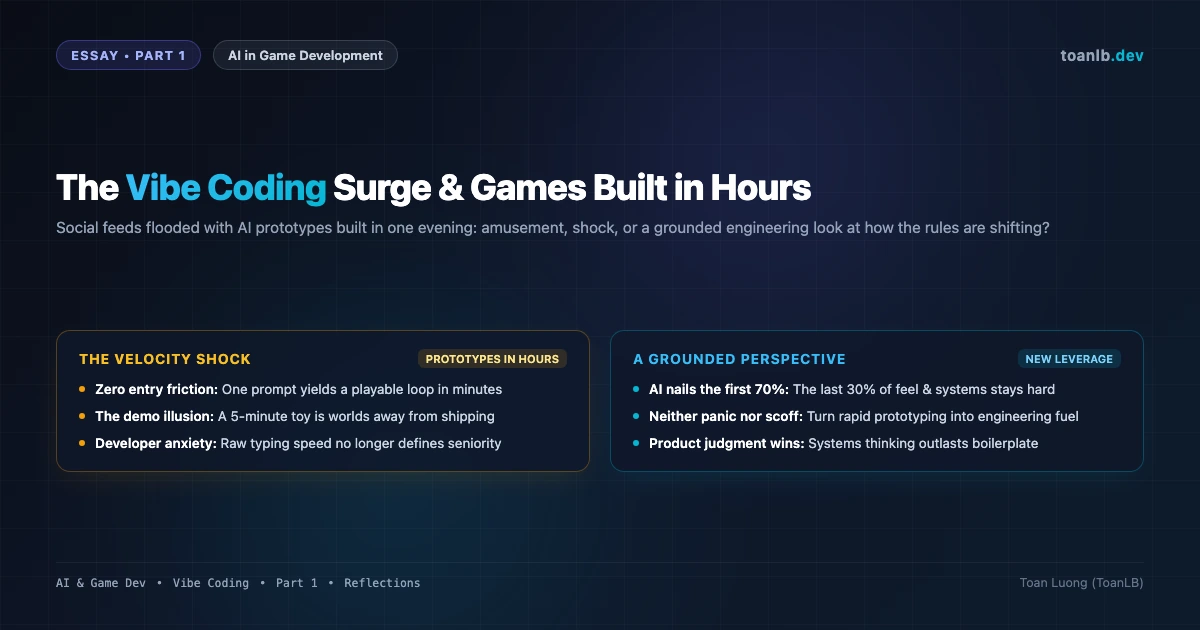
Open your phone and scroll through social feeds these days, and it is almost impossible not to run into someone showing off a game they just “vibe coded” in a couple of hours or a weekend.
Some posts are just a brisk two-liner; others are lengthy, heartfelt write-ups. But almost every single one ends with a link inviting the community to give it a spin.
Naturally, professional curiosity gets the better of me. Whenever I spot a quirky thumbnail or an intriguing prompt description, I click through to read more, then launch the game link to see what it is all about.
And sure enough, it runs. No installation required; almost all of them are lightweight web games. Personally, I do not play web games very often, but I always jump in out of curiosity to see how people built them. Some projects turn out surprisingly cohesive and polished; others are still rough around the edges.
Yet after test-playing a handful of these community creations, I have to admit: modern generative AI is truly impressive. Back when AI first emerged, simply having an interactive conversational assistant already felt like unlocking a new frontier - writing code faster than ever. Today, models ingest entire project contexts, scaffold file trees, and generate assets across the board - from pixel art sprites and frame animations to 3D models. AI has touched virtually every facet of the pipeline.
For folks without a technical background, figuring out what happens under the hood can be tricky. But AI takes care of that too: it picks the stack, whether JavaScript, TypeScript, HTML5 Canvas, or WebGL. It handles folder hierarchies, module separation, state wiring, and build scripts. The user never has to worry about dragging-and-dropping nodes or configuring build pipelines.
At that point, the creator’s job boils down to capturing the “vibe” they envision in a few sentences: “Build me a flying cat that dodges incoming flying sausages. Catching fish makes a meow sound, and as the score climbs higher, the background music gets increasingly intense.”
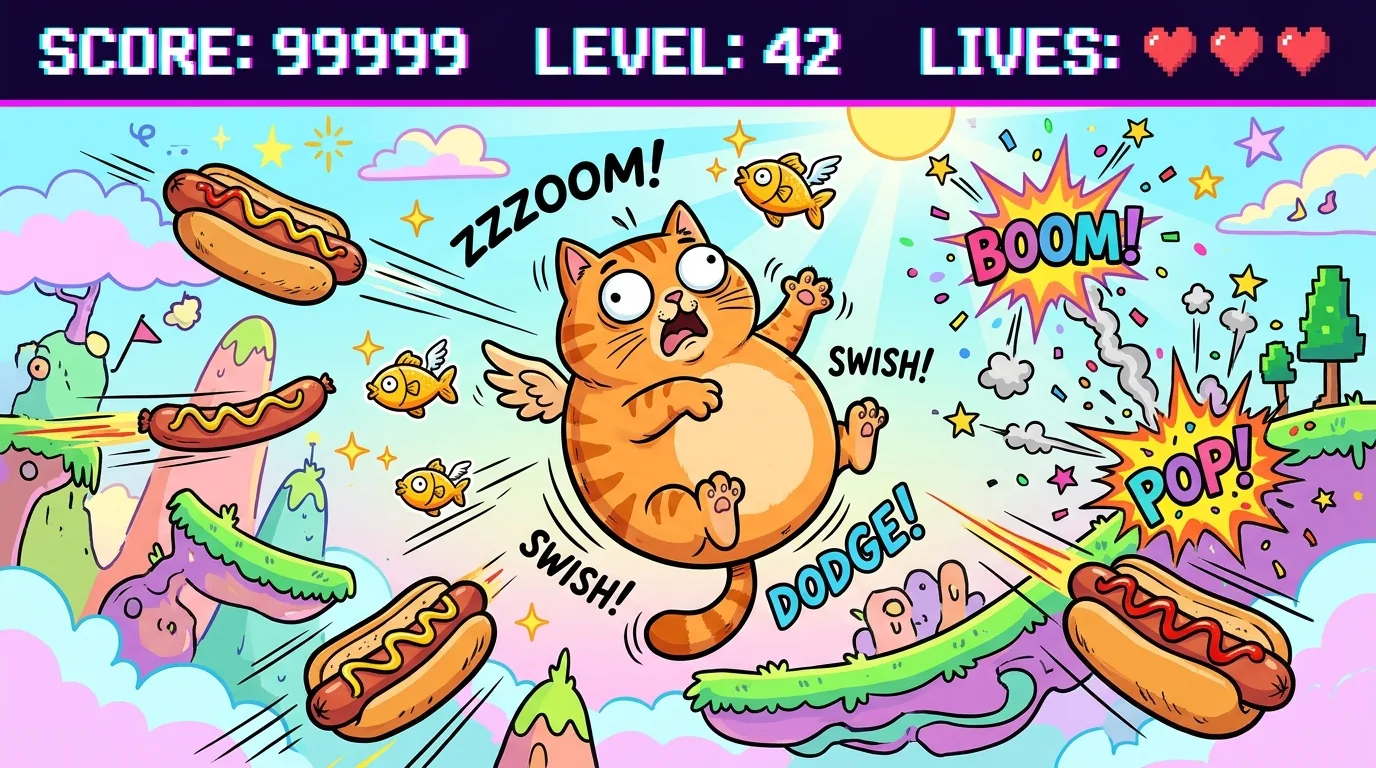
Calling it “vibe coding” makes it sound breezy and effortless. In reality, coaxing an AI to spit out a fully working, bug-free game still takes quite a bit of prompt wrestling and debating back and forth late into the night. But the payoff is immediate: hit deploy, and within seconds, a playable game lives on the web, ready to share with friends.
That is how the term “Vibe Coding” exploded into the mainstream. People with zero programming background can now create playable games. Anyone with a spontaneous idea can hold a working prototype in their hands after an evening of experimentation.
To be completely honest with you, during those first few days of watching my feed overflow with “built in two hours” games, something deep inside me felt… a bit uncomfortable.
Why uncomfortable?
Anyone who has spent years in game engineering probably knows the feeling. Back in the day, shipping even a modest, tiny game demanded an enormous investment of blood, sweat, and tears. You had to master a programming language, configure toolchains, read dense documentation, fight baffling bugs, and even when a feature finally worked in production, if the architecture was sloppy… you tore it down and refactored it from scratch.
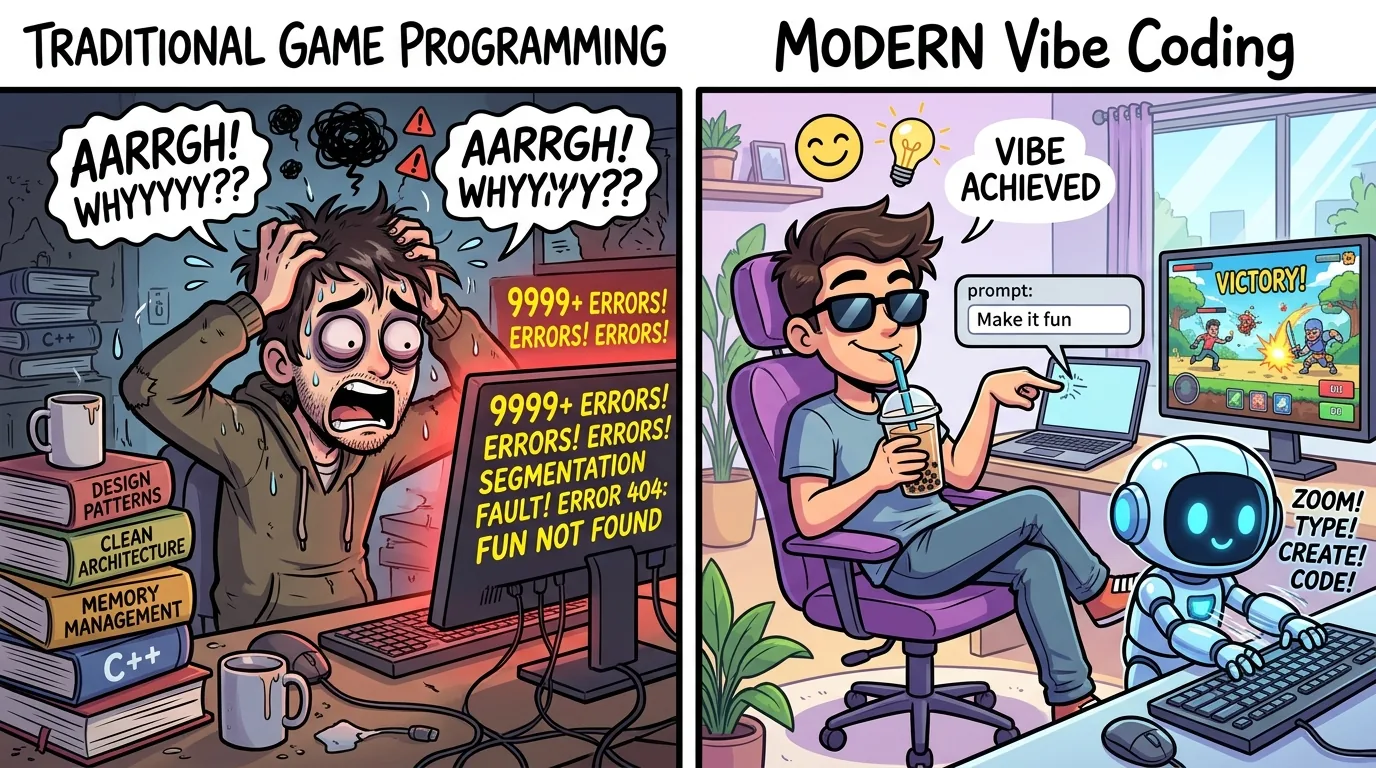
Now, you open your feed and see newcomers putting together working games in a single evening, proudly calling themselves game developers. Involuntarily, the “old craftsman” ego inside me flinched. The craft I had spent countless sleepless nights honing suddenly seemed… far too effortless in the eyes of the public.
Add to that the mild fatigue of scrolling through dozens of derivative titles: identical core loops, generic mechanics, mismatched assets with uncanny visual artifacts. Before long, you catch yourself flicking your thumb upward just to scroll past them faster.
Yet upon further reflection, I asked myself: why harbor that irritation in the first place?
Why do people create games? To experience joy, to entertain, to bring their imagination to life after an exhausting day at work. Turning a whimsical idea into an interactive toy on a screen, then sending the link to friends for a shared laugh - isn’t that one of the most delightful gifts modern technology can offer?
At the end of the day, games exist to serve human life and spark joy. As long as creators act with integrity, build in good spirits, and do not spam or bother anyone, whether a game is built from 1,000 hand-crafted lines of code or twenty AI prompts does not diminish its validity.
In fact, looking closely, quite a few non-engineers using AI have sculpted games with delightfully bizarre, inventive mechanics - concepts that veteran engineers like myself might never conceive, simply because our minds are too preoccupied with architectural purity and technical constraints. Watching them succeed is a humbling reminder that there is plenty to learn about how they frame problems and communicate intent to AI so effectively.
Framing it that way brings peace of mind.
Yet the question that lingered with me long after was not how capable AI has become. It was this: Why was my initial instinct as a veteran game developer to feel a pang of professional pride and resentment?
When we spend long enough in a trade, do we inevitably turn into stubborn “gatekeepers”, standing atop the walls and looking down skeptically at anyone taking a shortcut?
Let’s unpack that professional pride in the next essay.

