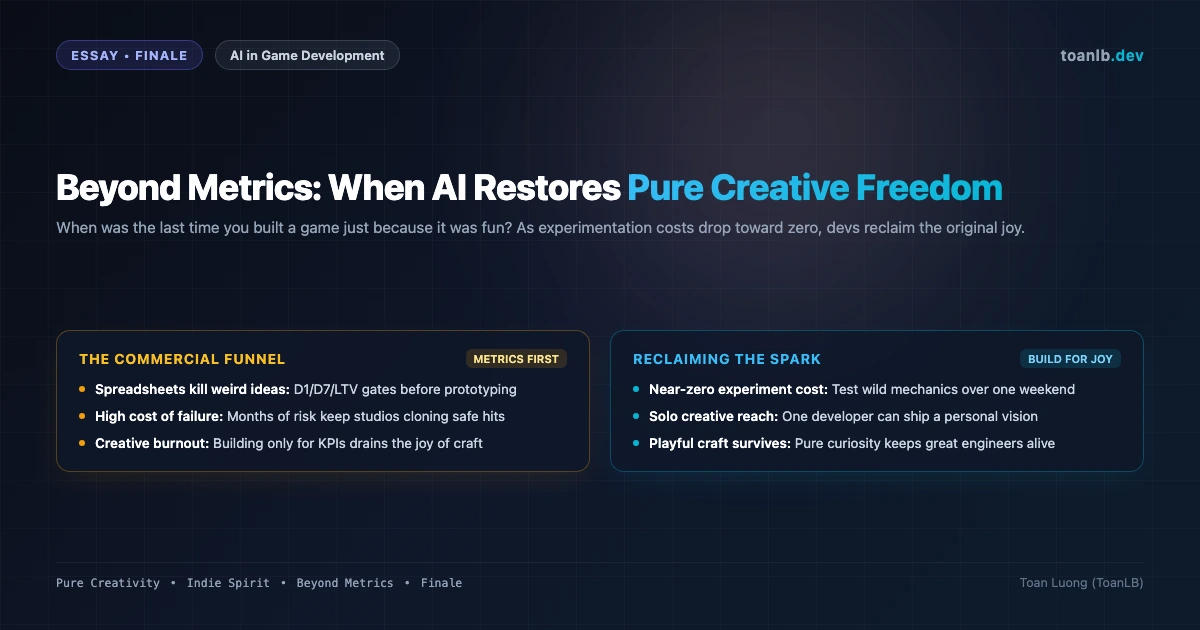
At the end of Part 4, after candidly admitting how I leverage AI daily to handle mechanical boilerplate and math derivations, I posed a contemplative question:
When AI shrinks the timeline for turning an abstract concept into a playable prototype from months to days, what is the ultimate gift game developers truly receive? Is it merely the capacity to grind out dozens of monetized titles per year to maximize ad revenue?
Today, sitting down with a warm cup of tea to write the concluding chapter of this five-part reflection series, I want to ask you an honest, searching question:
When was the last time you built a game simply because it was fun - without worrying whether Day-1 Retention hit 40% or CPI stayed below twenty cents?
Looking back at our earliest steps into this industry, almost all of us began with untainted passion and naive wonder.
Back then, we loved games with every fiber of our being. We fell in love with childhood worlds framed by bulky CRT monitors: splitting lives in Contra, cruising Vice City’s neon waterfront late into the night, or surviving relentless swarms in Alien Shooter in a cramped college dorm room.
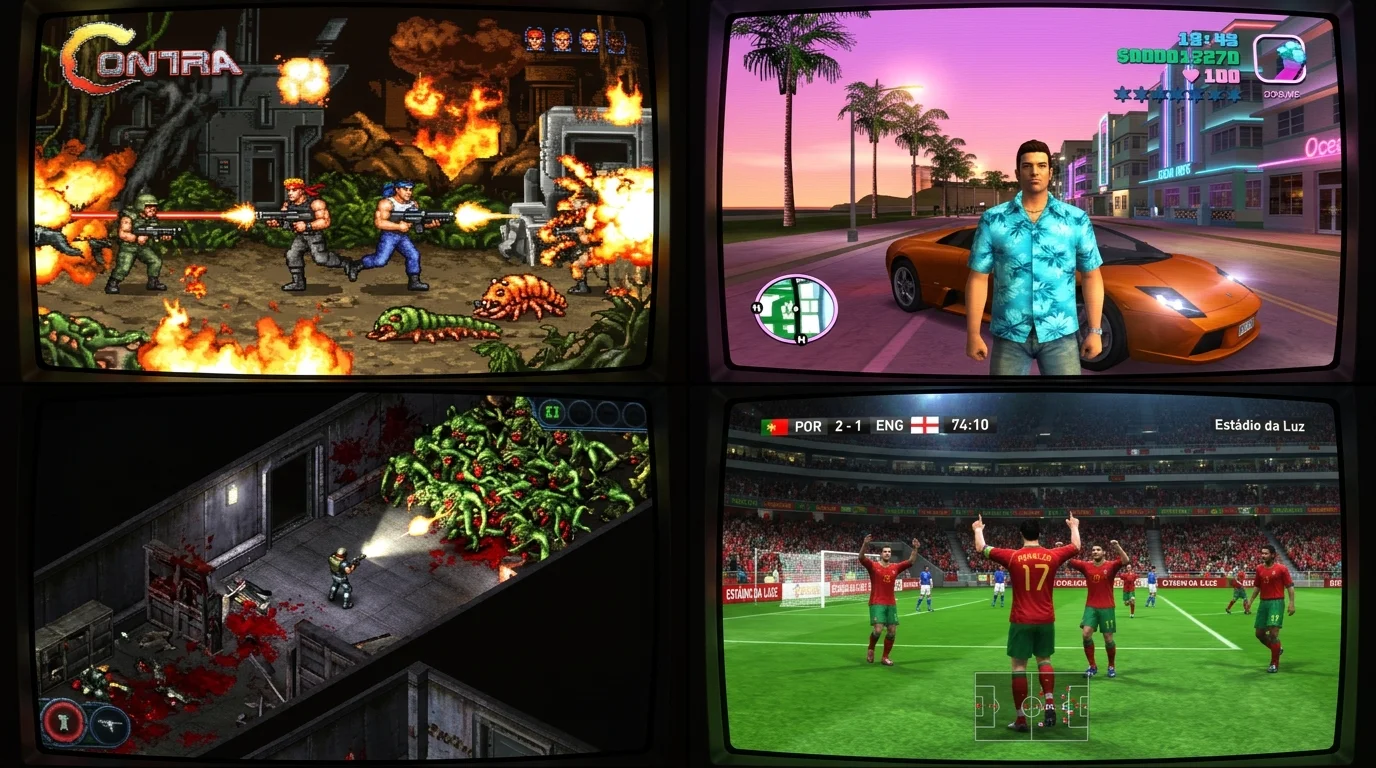
Those primal emotions drove us to install our first game engines, clunky compilers, and awkward scripts just to see a single textured square move across the screen. When our character jumped and triggered a simple collision sound, the thrill felt so sacred that we knew with certainty: We were born to make games.
Yet once we entered the commercial game industry, survival economics and spreadsheet metrics began tightening around our necks.
Everything gradually dissolved into sterile metrics: D1, D7, D30 Retention, ARPU, LTV, ROAS, Impressions, eCPM… Production meetings ceased to ask “does this combat mechanic feel visceral, does this narrative touch player hearts?” Instead, conversations pivoted to “how do we nudge players into watching an interstitial ad every 45 seconds, how do we maximize Day-3 conversion rates?”
Any eccentric, genuinely innovative creative premise was dismissed out of hand unless it could prove instant commercial viability on paper. We found ourselves sucked into cloning chart-topping hits, assembling the safest, most monetization-friendly loops.
After five or ten years of unyielding production sprints, our keyboards kept clacking and paychecks kept clearing, but the passionate spark of our youth had quietly suffocated under analytics dashboards. Shutting down our workstations at midnight, we couldn’t help but wonder: Are we still artists creating interactive worlds, or merely cog-wheels maintaining a cold monetization engine?
That is why, reflecting across this entire personal journey - from the initial shock of Vibe Coding, stepping past the gatekeeping trap, understanding the boundary between craft and synthetic slop, to embracing AI as a master craftsman’s assistant - I realized the crowning virtue of AI has nothing to do with industrial throughput.
The greatest gift AI offers to creators is this: It pulls the Cost of Experimentation straight down to absolute zero.
Historically, testing a quirky indie game concept as an individual was prohibitively expensive. You might harbor a brilliant, unconventional idea, but to make it playable, you had to build everything by hand: architect the runtime systems, sketch crude 2D sprites, hunt for free sound effects, and wrestle with endless engine quirks.
Even a modest prototype demanded six to twelve months of exhausting late nights. For developers balancing family responsibilities, young children, and grueling day jobs, that barrier was insurmountable. Countless whimsical ideas and heartfelt interactive stories withered away in dusty notebooks, never given a chance to breathe.
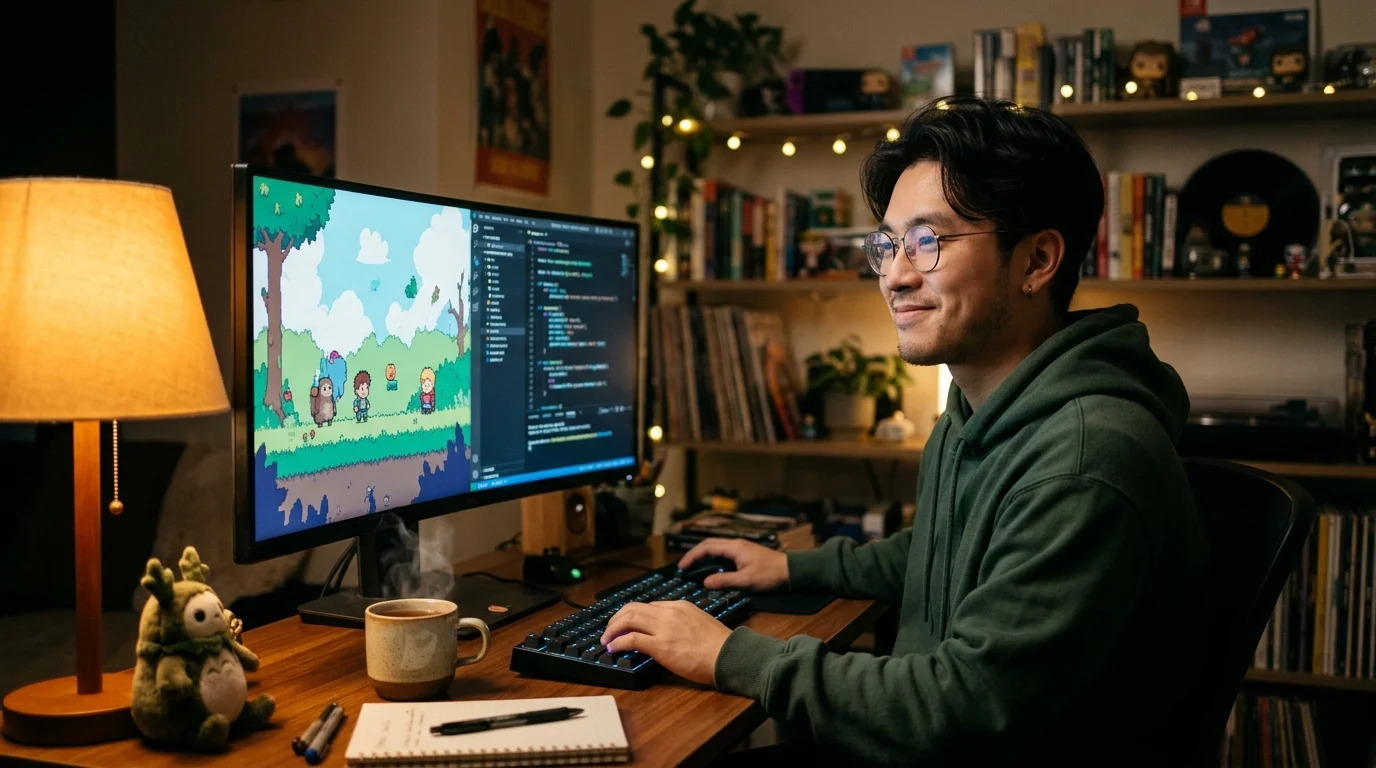
Now, with AI acting as an untiring copilot, the scales have tilted completely.
Over a quiet weekend or a brief holiday break, a solo developer can build a complete, tangible prototype with fluid controls, responsive audio, visual particle feedback, and engaging gameplay. AI shoulders the heavy mechanical scaffolding, giving you the shortest possible path between an ephemeral spark in your mind and an authentic interactive experience on screen.
When the barriers of time and manual friction dissolve, we step into a wondrous sanctuary: Pure Creative Freedom.
Imagine the feeling of crafting a game:
- With no executive producer or product manager looking over your shoulder to critique or veto.
- With zero need to contrive forced interstitial ad placements to boost monetization yield.
- With complete indifference to whether the market currently demands casual, hyper-casual, or puzzle mechanics.
- Where you build simply because: It is bizarre, it is hilarious, it fulfills an eccentric dream that came to you in the shower, or it preserves a cherished childhood memory.
It might be a bespoke micro-game crafted as an anniversary gift for your partner, navigating obstacles you both weathered in real life. It might be a silly interactive toy written for your toddler to tap and giggle at on a Saturday evening. Or perhaps a somber, idiosyncratic interactive novella that you know only a handful of kindred spirits will ever complete on itch.io.
Does commercial reach matter here? Not in the slightest.
Because when freed from transactional calculations and the anxiety of financial survival, your creation breathes with genuine human life. It is not an engineered attention trap; it is a fragment of your soul, an honest memory etched into code.
AI did not arrive to turn human beings into soulless automatons. On the contrary: AI has emancipated us from robotic, repetitive chores so that we may fully inhabit our most sacred human calling: The Joy of Creation.
The history of software engineering and game development has weathered many such inflection points.
In the earliest days, pioneers wrote games in raw machine code or assembly. When C and C++ gained prominence, veteran programmers worried that emerging developers would become intellectually soft by losing touch with CPU registers.
When modern game engines like Unity and Unreal arrived, critics argued that dragging and dropping components would dilute engineering discipline compared to rolling custom renderers with OpenGL or DirectX.
Yet time consistently proved the opposite: As tools become more expressive, the gates swing open for countless visionary storytellers who otherwise would have remained locked outside. Technology exists, in the final analysis, to serve human flourishing, spark joy, and liberate human labor.
AI will never rob a game of its soul. The soul of an interactive work has never resided in whether it was typed across ten thousand manual keystrokes or generated through iterative prompts.
The soul of a game has always resided in the heart, artistic taste, human decency, and authentic love of the person who brought it into being.
As we close this five-part reflection series, if there is a dormant game idea resting in your desk drawer or lingering in the back of your mind that you never dared to start:
Boot up your computer, brew a fresh cup of coffee, welcome AI as your quiet studio partner, and begin typing that very first prompt.
Go make games again - with the boundless curiosity, wonder, and unadulterated joy of day one.
P.S: That modest solo puzzle project I’ve been piecing together at midnight, after months of quiet tinkering alongside AI, is now running smoothly on an aging mobile phone. There are no venture capital funds backing it, no flashy marketing campaigns waiting, and it will probably never grace any million-download leaderboard. But every evening when I return home, unlock the phone, solve a puzzle, and smile in the quiet darkness, I know that the fire inside the boy who loved games decades ago is burning as bright and warm as ever. May you rediscover that very same fire for yourself! ☕