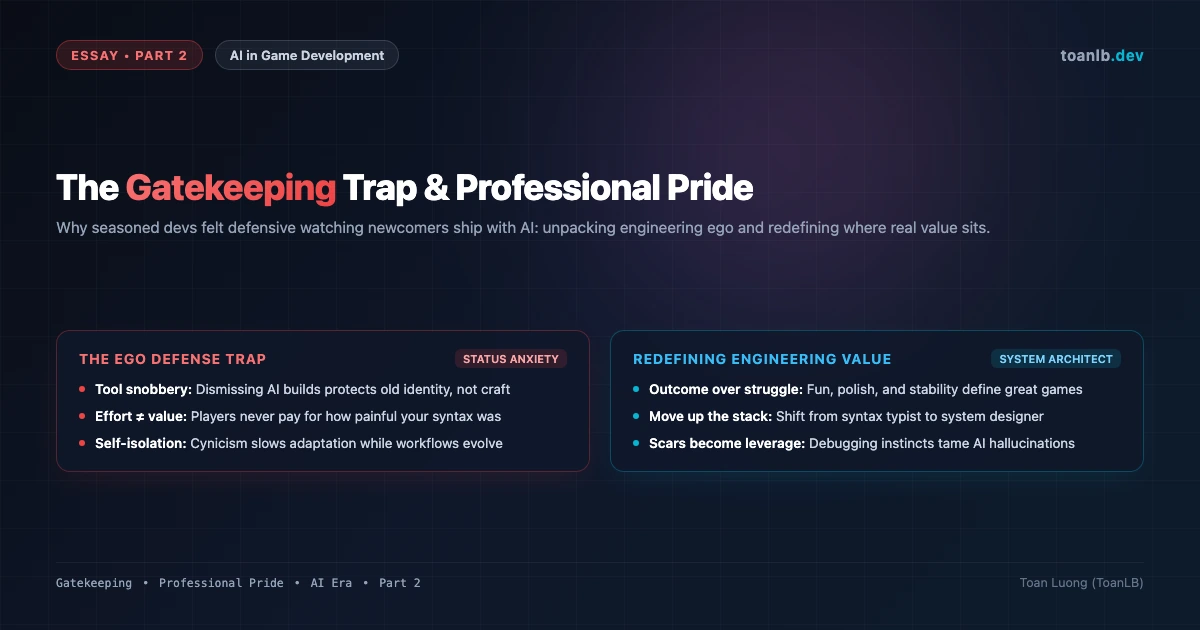
At the end of the previous post, I promised to have an honest conversation about an emotion that many seasoned developers have likely brushed against, even if we are reluctant to admit it out loud: professional pride.
Truth be told, during the early days when the “Vibe Coding” phenomenon erupted and people began showing off games assembled in a few hours of prompt writing, my reaction was not merely curiosity. Deep down, there was a subtle discomfort, a knot of irritation that was hard to put into words. In professional studio environments, shipping even a modest hyper-casual, casual, or puzzle title typically takes 1 to 2 months from project kickoff to store launch. Even in the early stages of generative AI when assistants were limited to basic Q&A, shipping a complete, stable game still demanded substantial time and effort.
The feeling was almost identical to that of a seasoned chef who has spent his entire youth in a professional kitchen: learning knife techniques, practicing uniform julienne cuts, tending gentle simmers for hours, and nursing a pot of bone broth for 12 straight hours just to extract a delicate, natural umami… Then suddenly, someone walks in, dumps an instant seasoning packet into boiling water, stirs for three minutes, serves the bowl, and proudly announces: “I am a chef!”.
Does it sting? Of course it does.
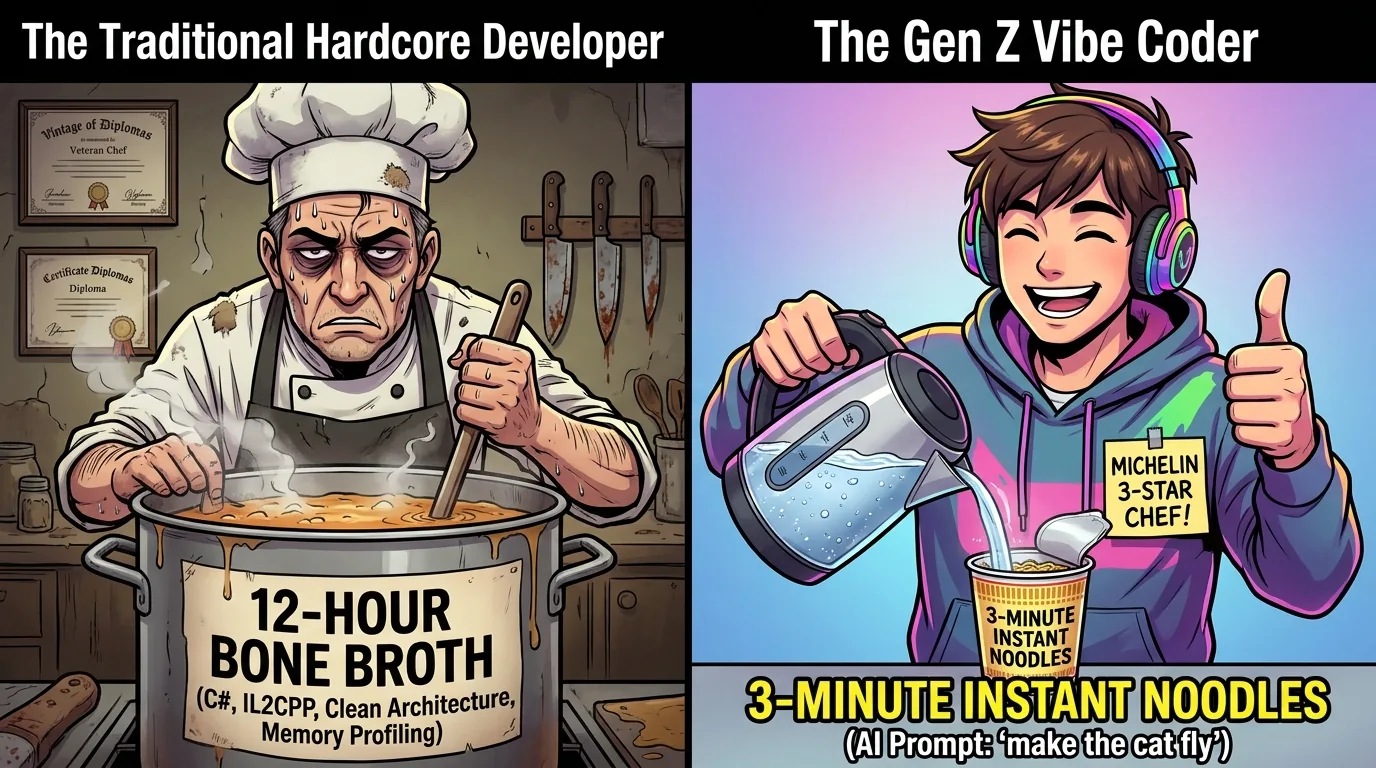
Looking back at the journey that my peers and I walked through, who didn’t endure years of grinding through grueling trials? Countless red-eyed nights tracing obscure NullReferenceException bugs, days spent dissecting IL2CPP translation output to understand how C# maps to native C++, or hours squinting at the Unity Profiler hunting down single-byte managed allocations to eliminate GC frame spikes.
We treated those technical scars as medals of honor - the non-negotiable price of admission required to call ourselves Game Developers.
Then, out of nowhere, AI arrived. People no longer need to know what a Stack or Heap is, nor do they need to worry about Garbage Collection cycles or Design Patterns. Just type a few natural-language sentences describing the vision, and the AI generates code, sprites, and sound effects. Characters jump, shoot, and tally scores smoothly.
In an unguarded moment, my gut reaction was: “That is wildly unfair!”.
Yet reducing this tension to mere juvenile envy would overlook the full picture. Beneath the professional pride of engineering veterans lie three very real, pragmatic concerns:
First is the fear of industry standards deteriorating. When building games becomes trivial and everyone can claim the title of developer, there is genuine anxiety that markets will be flooded with products that look slick on the outside but are hollow within. The underlying codebases become tangled nests of tech debt, held together by digital duct tape. Seasoned engineers worry that the superficial allure of “fast shipping” will erode respect for “sound engineering” - the technical depth that generations of practitioners spent decades cultivating.
Second is the fear of being relegated to “janitors”. Anyone with production experience knows: putting together a functional prototype is easy; maintaining and scaling it into a viable commercial product that survives months or years of live-ops is the real challenge. When vibe-coded projects swell in scope and AI models begin hallucinating - unable to untangle conflicting logic loops - who gets summoned to clean up the mess? Traditional developers. The prospect of having to clean up codebases born from pure carelessness naturally triggers friction.
Third is the fear of obsolescence. When AI executes the tasks we once labored over in a fraction of the time, does the economic value we provide to organizations diminish? Will experienced engineers find themselves sidelined as AI models grow increasingly capable?
Yet after many quiet nights of reflection, I had to confront myself: Why was I so defensive? Was I falling squarely into the Gatekeeping trap?
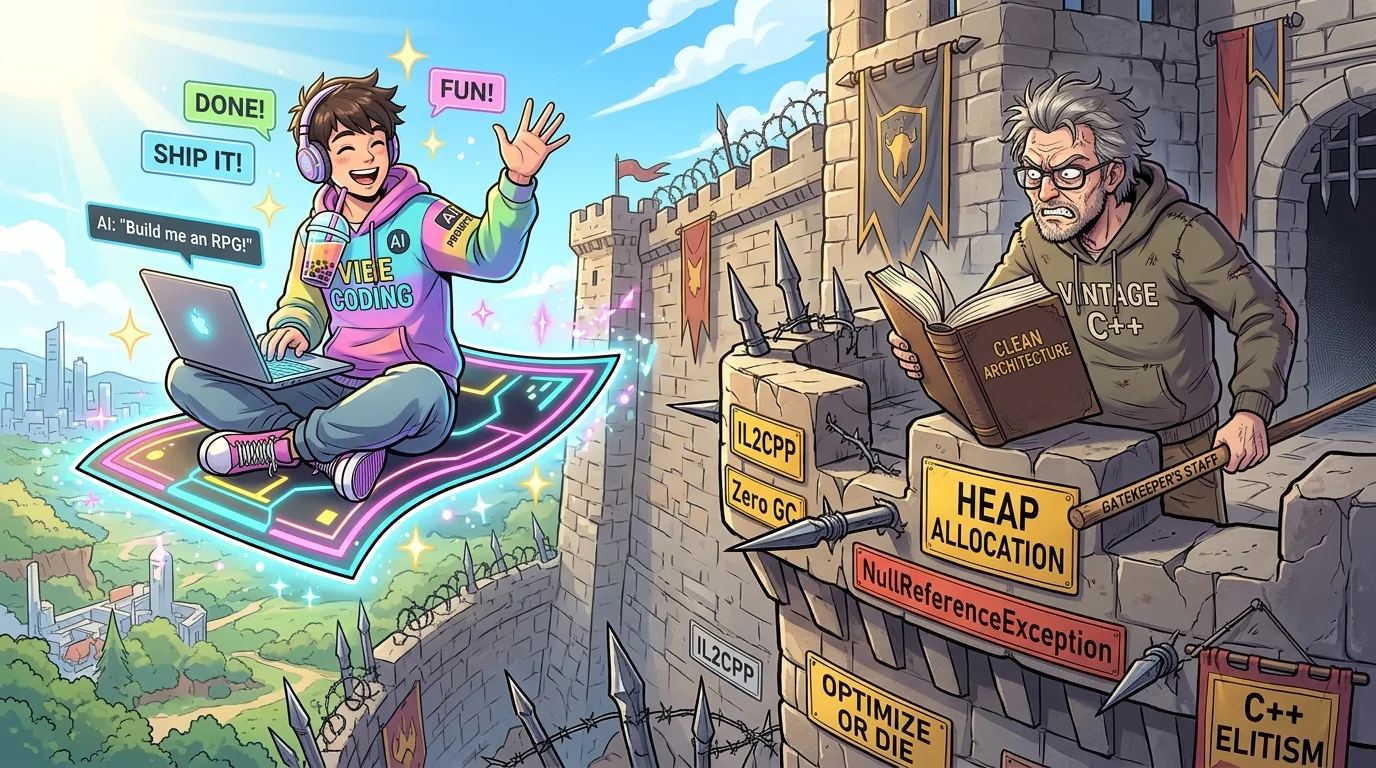
Gatekeeping - the behavior of self-appointed temple guardians. It happens when you have fought your way over a tall, thorn-covered stone wall, but instead of dropping a rope down to help others climb up, you stand atop the parapet looking down and proclaim: “These newcomers took a shortcut. If they didn’t suffer the way I suffered, they do not belong inside these gates.”
Realizing that struck me with a wave of humility and embarrassment.
Why did programming languages and game engines come into existence in the first place? They were created to serve people, solve problems, and bring entertainment into the world.
If an office worker spends their weekend prompting an AI to create a simple jumping cat game just to play with their partner and share a laugh, what is wrong with that? It is wonderful.
If a designer or marketer who harbored a game idea for years without knowing how to write code can now bring that dream to life, isn’t that a remarkable achievement of modern technology?
If someone uses AI to build interactive mini-games to generate extra income to support their family during difficult economic times, that is honest, decent work deserving of respect.
No institution - and certainly no individual engineer - holds the authority to issue licenses determining who is “worthy” of making a game. When you build walls to block newcomers simply because their path was not as grueling as yours, you are not protecting industry standards. You are merely protecting your own fragile ego.
Moreover, when I set aside that defensive pride and looked with an open mind, I realized I had plenty to learn from the very creators I once viewed as novices.
Many non-engineers leverage AI with remarkable ingenuity. Unburdened by dogmatic technical patterns, they possess sharp product instincts. They understand what players actually find entertaining, grasp social media trends effortlessly, and iterate at blinding speed. Engineers like myself often get so caught up in polishing individual lines of code and saving microseconds that we forget a foundational truth: A game built on the most theoretically elegant architecture in the universe has zero real-world value if nobody wants to play it.
Learning to shed the gatekeeper persona brought an immense sense of relief. Nowadays, when I see someone build something neat using AI, I jump in to play it, leave a thumbs-up, congratulate them, and ask how they structured their prompts to achieve that behavior. It is far more enjoyable, and it opens up fresh perspectives every single day.
Yet as technology swings the gates wide open and anyone can ship a playable game in an afternoon, another conundrum emerges:
Why have gaming communities across both international forums and local channels developed such an intense, visceral backlash against AI-labeled games, branding them as “AI-Slop”?
When technical execution is no longer a barrier, where does the fragile boundary lie between a “genuinely creative work” and a “soulless heap of digital junk (AI-Slop)”?
Let’s explore that in the next essay: the vital role of “Taste” and the survival of the game creator when tools become effortless.
P.S.: At my company, there is a talented colleague with a non-gaming background who, through sheer dedication and AI tooling, is currently writing his own specialized vehicle physics engine from scratch.
In the past, my knee-jerk reaction might have surfaced: “Why reinvent the wheel? Unity and Unreal have spent decades perfecting vehicle physics; why waste time building your own engine instead of just shipping a game?”
Today, I see it differently: why dampen someone’s genuine creative joy? If you feel inspired to build it, build it. Have fun with it. Even in my own solo game dev journey, people often ask why I chose to build a puzzle game in such a hyper-competitive red ocean. Who cares? Pour your heart into it and push your limits - you might just leave a meaningful mark on the world.

