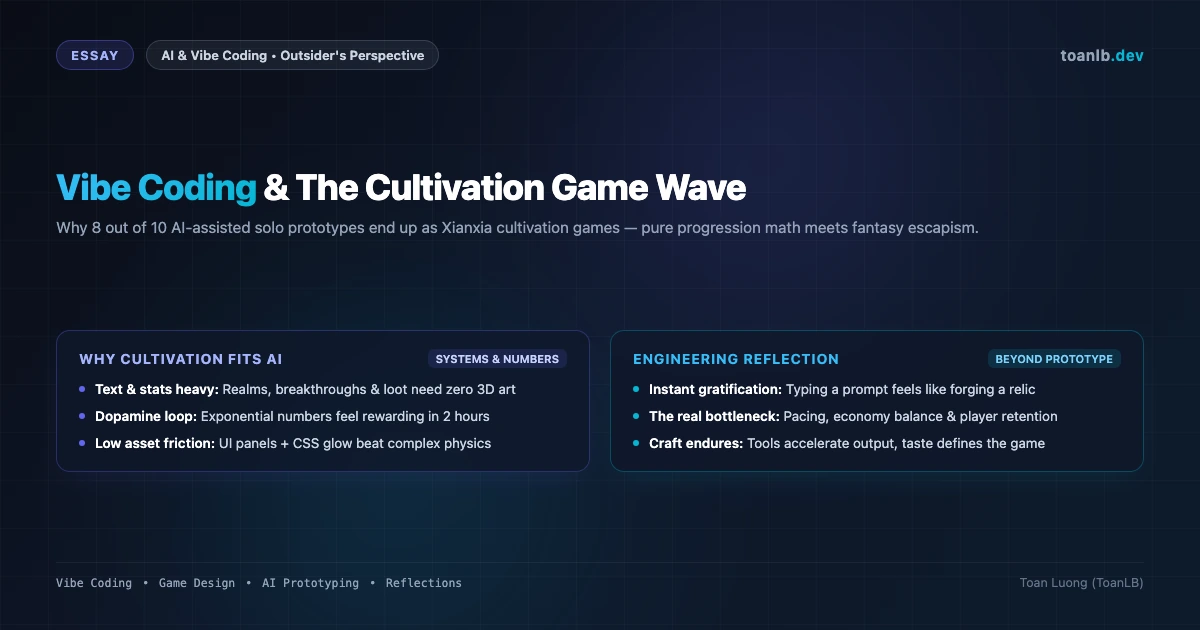
The other day while scrolling through social feeds, I stumbled upon a witty comment inside a game developer group: “Out of ten game developers, nine are vibe coding; and out of those nine, eight are building cultivation games.”
It made me chuckle, but there was plenty of truth to it. Feeds really were overflowing with people building Xianxia and cultivation games. Yet it left me genuinely curious: why this specific genre?
To be completely honest, I am an absolute outsider to the entire cultivation realm. I have never read a Xianxia web novel, I have no clue what the various breakthrough realms or tribulation stages actually mean, and martial arts dramas or fantasy swordplay sagas have never managed to captivate my attention.
My journey as a gamer has always been rather uncomplicated. Growing up in a quiet countryside town with few internet cafes, gaming began with family disc consoles: Contra, Super Mario, rescuing the princess, and whatever odd titles we could sneak in when parents were not looking.
When personal computers finally arrived, my gaming landscape remained anchored elsewhere. I was immersed in Grand Theft Auto: Vice City (running errands across town with Tommy Vercetti), Alien Shooter (punching in cheat codes before unleashing chaos on relentless swarms of monsters), and localized community mods of PES 6 (where I even edited custom kits to paste my own photo onto player jerseys). Later in college dorms, there was casual Counter-Strike with roommates, followed by mobile puzzles and casual games once I entered the industry professionally. On long evenings, I would lose myself in video essays breaking down the rich lore of Assassin’s Creed or the emotional depth of The Last of Us. The vast expanse of immortal cultivation never once crossed my radar.

Yet through the lens of an engineer, the current phenomenon is fascinating. That passing joke captures something genuinely profound about how generative AI is reshaping modern developer habits.
Why Cultivation Games and Not Something Else?
Strip away the traditional oriental ink-wash aesthetics and archaic poetic vocabulary, and the architectural core of most web-based cultivation games is astonishingly streamlined: it revolves almost entirely around numerical attributes, resources, and an incremental progression loop. The avatar can remain entirely stationary; stats tick upward on an automated timer, and once resources meet a threshold, clicking a button attempts a breakthrough to the next tier. There is no strict necessity for Newtonian physics, continuous collision detection, 3D spatial transformations, or complex bone hierarchies.

And this is precisely the domain where modern coding assistants like Claude or Cursor excel. If you ask an LLM to generate an action platformer or a fast-paced shooter, it can certainly scaffold a playable prototype. However, as soon as you delve into tight player locomotion, kinematic collision matrices, state rollback, or framerate pacing, the engineering complexity balloons exponentially.
Conversely, if you ask an AI to construct a web application featuring an incremental progression system, automated stat timers, condition validation, and probability calculations on button clicks, it delivers clean, functional code within minutes. Systems with explicit rules, deterministic inputs, and bounded outputs are naturally straightforward for generative models to implement and debug.
The visual pipeline benefits from an identical dynamic. For solo developers, art production is consistently the steepest bottleneck. Cultivation games drastically soften that barrier. With generative image tools, one can effortlessly produce classical ink-wash landscapes, pair them with flowing calligraphic typography, overlay poetic flavor text on dark backdrops, and immediately evoke an atmospheric aesthetic. Crafting a cohesive, commercial-grade art direction still demands considerable dedication, but the initial friction has dropped precipitously. A developer without illustration skills can now manifest a cohesive visual wrapper without commissioning an artist from day one.
The barrier to bringing a functional, aesthetically pleasing game to life has collapsed to historical lows.
Yet precisely because the opening sprint is so frictionless, developers rapidly collide with an inevitable wall.
On evening one, after a handful of conversational prompts, you press refresh in your browser: numbers tick smoothly, mechanics respond, and dopamine surges. I analyzed this psychological surge in detail in AI in Game Development (Part 1): The Shockwave of Vibe Coding, where technical barriers evaporate overnight. It feels as though a complete, polished game is only a few evenings of prompting away from launch.
Then comes the subsequent leg of the journey, where momentum grinds to a halt.
When you attempt to deepen the experience - introducing multifaceted equipment mechanics, interdependent elemental affixes, or persistent cloud saves - the AI-scaffolded codebase reveals its tangled seams. Because no overarching architectural blueprint was established from the outset, stitching together piecemeal generated snippets leads to fragile spaghetti logic. Debugging unfamiliar, machine-generated code often proves far more exhausting than engineering it cleanly from first principles. Countless projects stall right here, abandoned amidst a maze of fragmented logic.
More critically lies the experiential question. An AI can reliably generate rhythmic number increments, but it possesses no innate intuition for what makes an interactive experience genuinely captivating. A game where players merely click buttons to watch numerical counters inflate is functionally little more than a styled spreadsheet. It borders dangerously close to the soulless AI-Slop trap analyzed in Part 3 — experiences that proliferate effortlessly but lack taste, creative friction, and soul. After ten minutes of initial novelty, players close the browser tab because the loop lacks tension, stakes, or enduring emotional resonance.
Yet despite knowing that most of these experimental projects will never reach commercial fruition, I find this wave genuinely inspiring.
The daily routine of an engineer in the software industry is fraught with systemic constraints. We build according to corporate roadmaps, untangle legacy technical debt left behind by predecessors, chase tight production milestones, and rarely possess the autonomy to dictate features on our own terms.
Against that backdrop, opening an AI interface late at night in an empty room and building an interactive world from a blank canvas offers profound creative liberation. You decide what the interface looks like, how mechanics balance, and where every button sits - without asking for committee approval or navigating design consensus.

Watching peers meticulously iron out browser quirks just to share a playable link with friends — rather than judging from atop the walls of the Gatekeeping Trap analyzed in Part 2 — reflects the raw, original spirit of technology: the joy of tinkering, creating, and breathing life into something of one’s own, however modest the initial prototype may be.
I still know virtually nothing about Xianxia cultivation, and perhaps I never will. But whenever someone drops a link to a fresh web game they just built, I still click through with genuine excitement.
Tools evolve and the mechanics of writing code look vastly different today than years ago. Yet the simple, authentic joy of watching something you built with your own hands run on a screen remains completely timeless.

