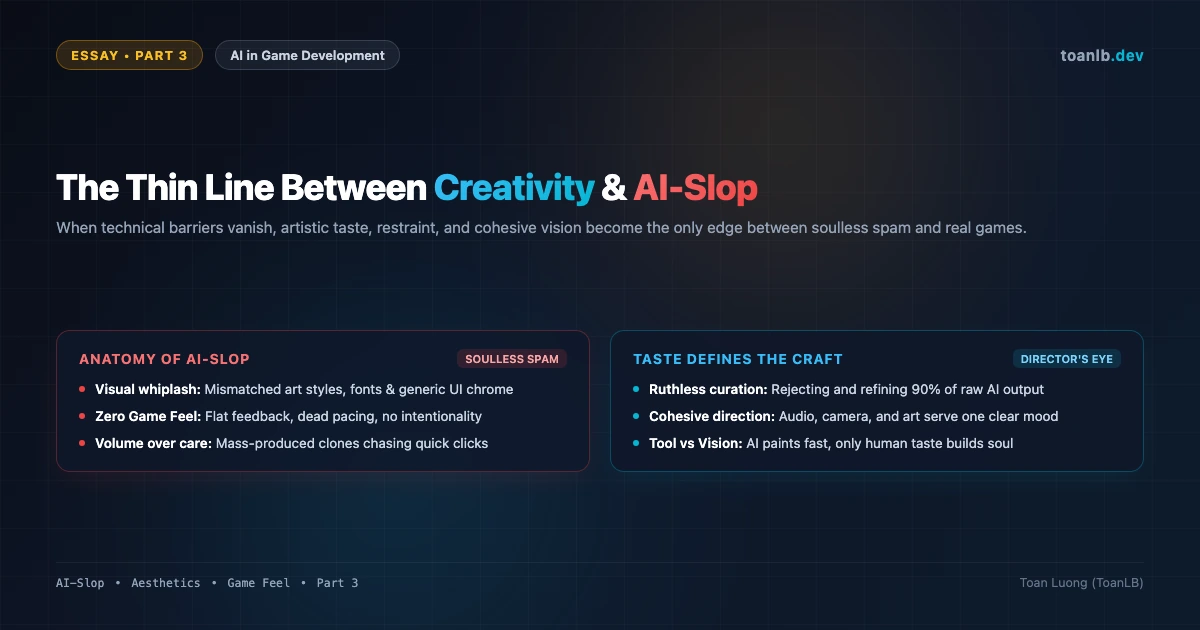
At the end of the previous episode, after unpacking the journey of letting go of professional pride and stepping around the gatekeeping trap, I left an open question:
If anyone can assemble a playable game after an afternoon of prompting, why have gaming communities across both international forums and local channels developed such an intense backlash against AI-labeled games? Why has the term “AI-Slop” become a badge of dishonor and a slap in the face to anyone caught abusing it?
Today, with a warm cup of tea in hand, I want to explore that tension with you: Where does the fragile boundary lie between a genuinely creative work and a soulless heap of digital junk?
What Exactly Is “Slop”?
In traditional English usage, “slop” refers to kitchen scraps, watery leftovers, or unappetizing refuse mixed together and dumped into a trough for livestock to consume.
When the term “AI-Slop” emerged online, it carried a biting sting. It does not condemn machine learning algorithms themselves. Rather, it describes synthetic products assembled hastily, lazily, and without care - produced en masse with a singular motive: to manipulate search algorithms, harvest views, monetize interstitial ads, or cash in on app store volume.
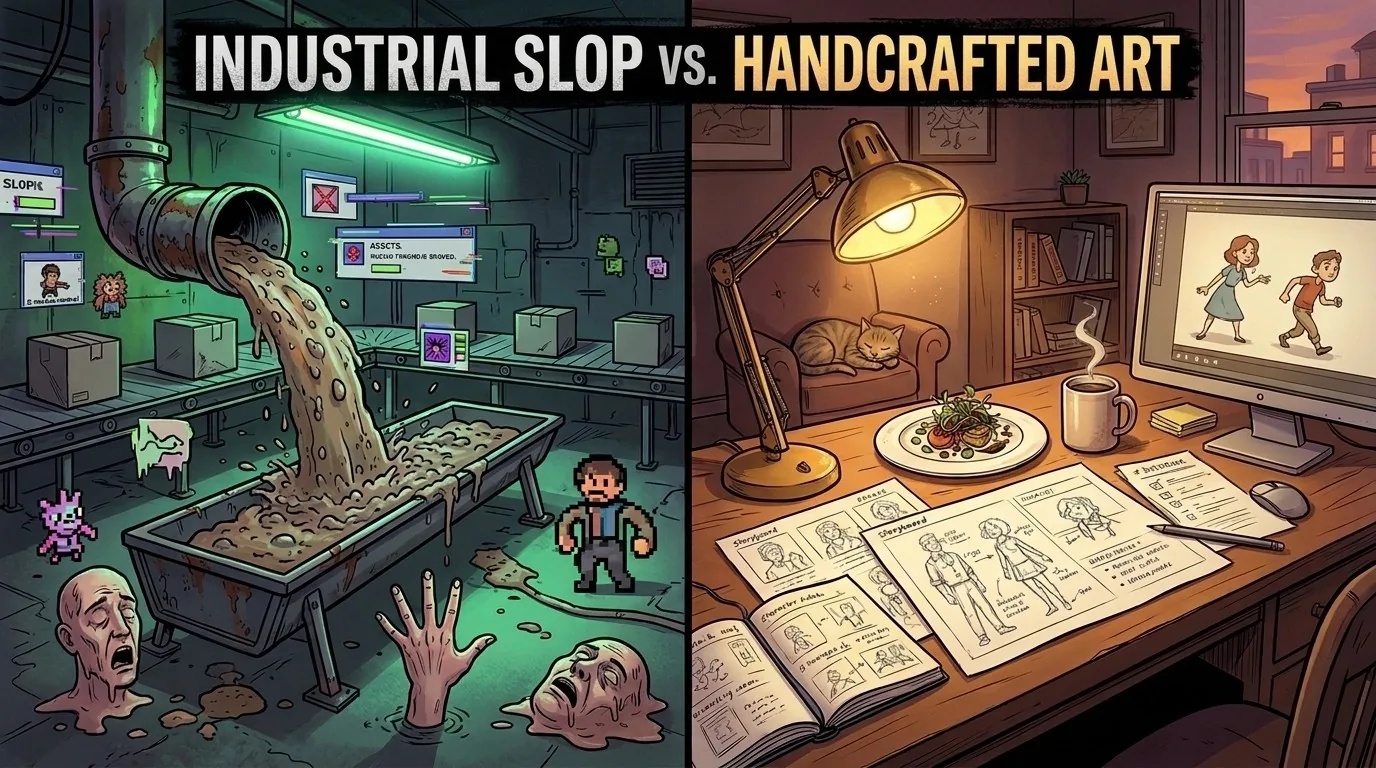
Browsing through Steam, Google Play, or itch.io lately, you can immediately detect the telltale hallmarks of AI-slop games:
- Glitzy Yet Incoherent Art (Visual Dissonance): The female protagonist looks like a million-view Midjourney render at first glance, but a closer look reveals six fingers, locks of hair clipping through shoulder plates, and lighting coming from the left while shadows fall to the left as well. Worse still is the jarring clash of styles: a 16-bit retro pixel-art background paired with a photorealistic 3D monster, topped by UI health bars lifted verbatim from a free anime asset pack.
- Hollow, Weightless Game Feel: Characters glide across terrain like ghosts without mass, inertia, or surface friction. Hitting an enemy produces zero microsecond hitstop, no camera shake, and no punchy audio feedback. Pressing buttons on a keyboard or tapping the screen feels like poking an unresponsive block of gelatin.
- Bloated, Bland Narrative (Chatbot Syndrome): Dialogue rambles on endlessly. Sentences are grammatically impeccable yet read as flat and sterile as a generic ChatGPT template. There is no subtext, no idiosyncratic character voice, and no meaningful silence between lines.
Yet the primary issue is not simply that these games are mediocre. The industry has never suffered from a shortage of bad games.
What provokes player fury and triggers review bombs is something much deeper: players feel fundamentally disrespected.
Gamers will gladly forgive an indie title with crude pixel graphics and rough sketches made by a solo developer toiling away in a cramped apartment, provided they feel the sincerity, passion, and care poured into every line of dialogue and puzzle room. But they will instinctively slam the “Refund” button and leave a scathing red review if they realize the creator spent three hours typing prompts, duct-taped together disjointed scripts, and tossed it onto the store hoping to scrape pocket change from their wallets.
Opportunistic cynicism and contempt for the player’s time - that is the true breeding ground of “AI-Slop”.
The Technological Paradox: As Barriers Drop to Zero, “Taste” Becomes Priceless
History consistently illustrates a simple truth: the easier the tools become, the more product volume explodes exponentially, yet the rarer genuine excellence becomes.
Holding a paintbrush does not make someone Leonardo da Vinci.
Opening a word processor does not turn anyone into a Nobel laureate in literature.
And a subscription to Claude or ChatGPT will never magically transform someone into an exceptional Game Designer.
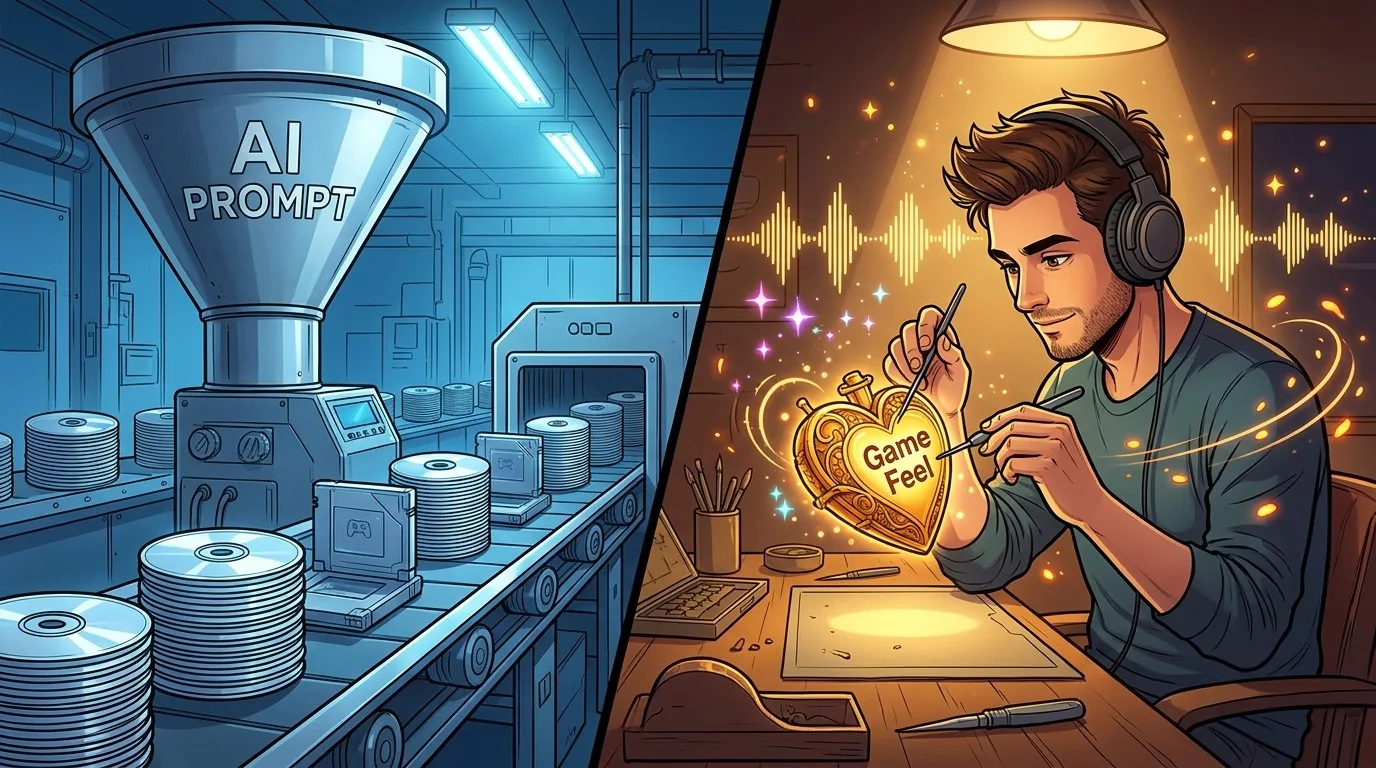
In the past, the engineering barrier to entry in game development was steep. To make a simple character jump and land, you had to understand vector mathematics, handle deltaTime, implement collision detection, configure rigidbodies, and fine-tune animation curves. That demanding barrier acted as a natural filter. It selected for creators with the patience, dedication, and resilience required to see a project through to completion.
Today, AI flattens that technical barrier completely. You tell an AI: “Write me a smooth double jump mechanic with dust particle trails behind the character’s heels” - five seconds later, the code sits on your screen, complete with particle emission routines.
When technical execution becomes a universal commodity accessible with a single prompt, the only remaining differentiators separating a craftsman from a spammer are: Aesthetic Taste, Game Feel, and Craftsmanship.
1. Aesthetic Taste: The Courage to Reject Mediocrity
An AI can generate 1,000 concept art images in an afternoon. But the model has no artistic eye. It cannot evaluate which composition guides the player’s gaze or which color palette conveys the quiet melancholy of a winter twilight.
Your “Taste” - forged across years of reading books, watching films, listening to music, and experiencing life - is the sole compass that decides: which image to keep, which 999 to discard, and critically: where the AI erred so you can open Photoshop and manually paint in the correct highlights to serve your artistic vision.
Taste is not about the raw computing power of your tools; it is about whether your standards are demanding enough to say “No” to hasty mediocrity.
2. Game Feel: Where Generative AI Remains Helpless
An AI can output a textbook Newtonian kinematic jump function: . But it does not grasp the subtle nuances separating the jump in Super Mario from the jump in Hollow Knight:
- Why releasing the jump button early causes the character to drop immediately (Variable Jump Height)?
- Why walking off a ledge still allows a jump input for 0.1 seconds (Coyote Time)?
- Why pressing the jump key 0.1 seconds before landing caches the input so the character bounces the instant it touches ground (Jump Buffering)?
- Why hitting an enemy must pause the frame for 4 frames (Hitstop / Hitpause), accompanied by a crisp metallic chime and a 3-pixel screen shudder to deliver visceral tactile feedback?
Those microsecond subtleties define Game Feel: the kinetic soul of a game. AI has no hands to hold a gamepad, no fingers to press keys, and no nervous system to register the surge of adrenaline during a near-miss evasion.
Achieving great Game Feel requires the creator to play their own game hundreds, thousands of times. It demands nudging a float value from 0.15 to 0.18, adjusting ease curves on the camera, and polishing until the response feels instinctively right.
3. Craftsmanship and Integrity: Respecting the Player
There is nothing wrong with using AI to accelerate development. The real question is: what do you do with the time saved?
Do you rush to spam ten more generic clones for ad revenue?
Or do you channel those reclaimed hours into polishing UI buttons so they feel responsive, designing comfortable click sounds, trimming memory footprint so low-end mobile devices don’t overheat, and penning an ending that genuinely moves people?
Intelligent players can sense developer craftsmanship within the first thirty seconds of navigating a main menu. It radiates through the care given to the smallest details.
How to Use AI Without Producing “Slop”
I would never advise anyone to abandon AI. Refusing an excavator to continue digging with a spoon in this era is sheer stubbornness.
Yet if we wish to harness AI while retaining the dignity and pride of our craft, we must remember a simple principle:
Use AI to lay the foundation and erect the structural pillars, but let your own hands and mind choose the paint, place the table, arrange the flowers, and light the lamp in that home.
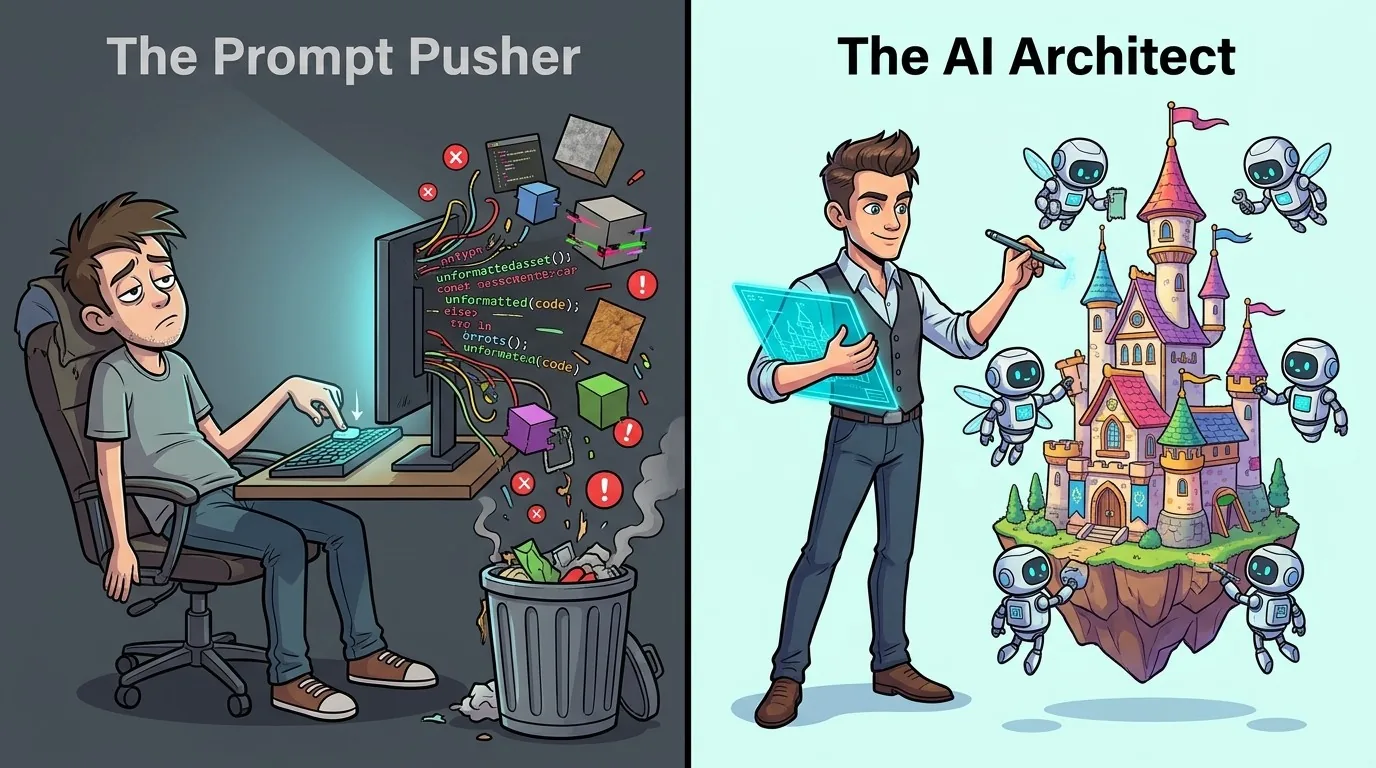
Never settle for being a “passive prompt courier”, copying AI output directly into a repository without reading or validating it. Act instead as a demanding creative director:
- Hold AI to your own rigorous standards; do not lower your standards to accommodate the noisy first draft an AI produces.
- If you lack formal art training, learn the foundational visual principles: the rule of thirds, the color wheel, contrast, and visual hierarchy to evaluate and refine assets.
- If you use AI to brainstorm dialogue, treat it as a sparring partner to explore angles, but write the final prose with your own lived human experience and voice.
Building a modest game is completely fine. Using minimalist geometric shapes is equally valid - just look at Thomas Was Alone or Tetris. What matters is building with sincerity, passion, and creative self-respect.
When you pour authentic care into a project, whether you rely on AI for 10% or 90% of the heavy lifting, players will feel the warmth inside the game. Conversely, if a project is driven solely by impatience and opportunistic shortcuts, it will inevitably remain “AI-Slop”, lost in the forgotten corners of the internet.
Critiquing Others Is Easy - What About My Own Workflow?
Writing these words to critique “AI-Slop” and pontificate on “Taste” sounds noble. But criticizing others is always easier than holding a mirror up to oneself.
You might reasonably ask: “Toan, you have worked as a traditional Unity engineer for nearly a decade… How do you actually use AI in your day-to-day game development? Are you ‘cheating’, and how has AI genuinely transformed your desk?”
That is a fair and important question.
In the next episode, I will pull back the curtain and share an honest, unfiltered account: How I leverage AI daily as a technical engineer - from generating math tooling and eliminating boilerplate code to the humorous, baffling debugging mishaps along the way.
Until Episode 4! ☕