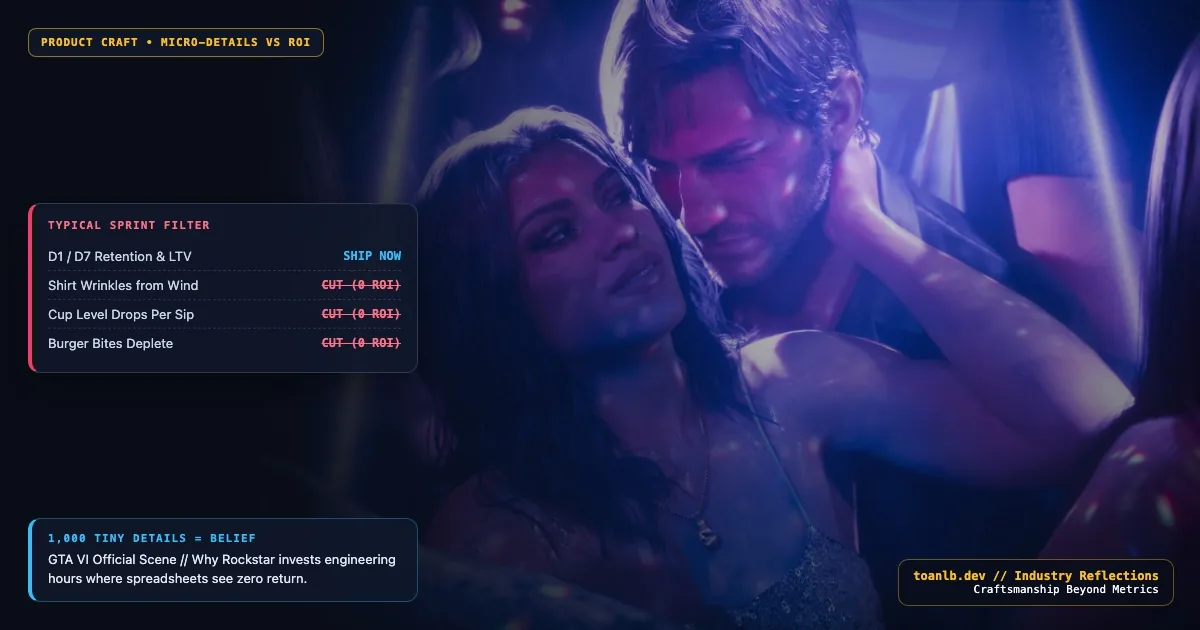
Let me be completely honest right from the first line: I am not the kind of gamer who has grinded through every Grand Theft Auto installment since childhood, and even amid this past week’s GTA VI frenzy, I still have not had the chance to play it myself - I have only “played it on YouTube” so far. =))))
Yet after nearly a decade as a game developer, even though I have since moved into a different domain, the game dev blood still makes it impossible to ignore GTA VI flooding every corner of the internet. Not the multi-billion-dollar revenue headlines, nor the memes about calling in sick to play. What held my attention longest were the comparison videos pitting GTA VI against earlier entries and its sibling Red Dead Redemption II over absurdly tiny details Rockstar crammed into their worlds: sipping from a takeaway cup visibly lowers the drink level, biting into a hamburger wears the burger down piece by piece, alongside dozens of other microscopic touches.
In this piece, I want to put the mindset of the studios I used to work at next to Rockstar’s approach. Obviously you cannot compare them on equal footing - my years in the industry were spent at mobile game studios (puzzle, casual…) shipping projects that are barely a tiny fraction of GTA’s scale - so what I really want to look at is simply our attitude toward micro-details in games. =))
The details that never survive Sprint Planning
Anyone who has worked at a commercial game studio, especially in mobile or live-ops, knows the classic Monday-morning question from a Product Manager by heart:
“How many man-days does this feature take? And which metric does it move?”
Inside the survival grind, everything has to translate into a spreadsheet: will this lift Day-1 Retention by 2%, push LTV up, or get more players tapping on an ad? If a task cannot prove its ability to generate revenue or keep users hooked on a chart, it gets crossed off the board on the spot. On projects where the deadline is only two weeks away, developers even have to swallow their pride and strip back clean architecture just to ship a test build for marketing campaigns.
Looking over at what Rockstar does with GTA or RDR, it feels like they live on an entirely different planet. Though saying that might be stretching it a bit - really it comes down to how each side views the medium, and where each studio finds its sweet spot between meticulous detail, engineering cost, and expected return.

Players are already spotting details in GTA VI that would sound like a joke if pitched in a regular sprint meeting: the protagonist’s t-shirt visibly creases and ripples under the downwash of a nearby helicopter’s rotors; dark alleys pile up real 3D physics-enabled trash rather than pasting a flat ground texture; the lead even handles mundane chores like feeding a pet snake or fixing a rotten staircase in his apartment.
Look back at GTA V or GTA IV and the same obsession is everywhere. Wet clothes after a swim dry gradually from the shoulders down to the cuffs in the sun. Miss a turn while driving and the character’s hand reaches off the wheel to tap the dashboard GPS to reroute. Enter a long tunnel and the car radio fades into static. Pull out your phone in front of an aggressive NPC and the AI assumes you are calling the cops and bolts in panic.
Not a single one of those details directly sells an extra in-app bundle.
When a thousand “pointless” touches add up to belief
So why would a multi-billion-dollar company burn thousands of hours from some of the best engineers in the industry on things ninety percent of players rush past without noticing?
In the final chapter of my reflection series on making games beyond metrics, I wrote about how easy it is to lose that original spark once dashboards and Excel sheets surround your desk. Watching Rockstar obsess over micro-details, a blunt truth of experience design stands out:
One tiny detail may have zero ROI, but a thousand tiny details stacked together create the most valuable currency in any virtual world: belief.
When players see a phone screen glow across a character’s face at night, watch spilled gasoline burn backward along the trail into an exploding car, or watch individual coins bounce out of a shot vending machine, the brain quietly registers a signal: “This world is real.” Once players believe the world is actually alive rather than a cardboard stage built to empty their wallets, every interaction carries completely different weight.

That is also what separates a product crafted with genuine love and good taste and game feel from a soulless industrial assembly line. Players are sharp. They can tell immediately when a studio respects every minute of their experience, and when a studio is only stuffing in another button to squeeze revenue.
To be fair: Not everyone has the privilege to build like Rockstar
I am not writing this to beat myself up or look down on everyone grinding away on mobile and casual games out there.
Let us be completely fair: Rockstar can afford to build this way because GTA Online has printed cash to sustain thousands of staff for over a decade, they own their internal engine end-to-end, and they are not pressured by shareholders to ship a brand-new title every single year.
Most of us in the real world are builders operating inside tight, unforgiving constraints. Monthly payroll for the whole team, server bills, rising user acquisition costs - none of that leaves room for a small studio to burn two years perfecting water physics or shirt fabric wrinkles. Under those conditions, knowing what non-essential polish to cut so the product survives month one is a real survival skill, not a sin.
Yet staying pragmatic enough to survive does not mean letting our craft grow completely numb.
No matter how tight a project’s budget is, there is almost always room for a couple of “off-spreadsheet details”: a slightly punchier impact sound, a subtle camera thump the exact frame a character lands, or a hidden line of dialogue waiting for anyone curious enough to wander off the main path. Those touches barely cost an extra day of work, yet they remind us that behind the task boards and deadlines, we are still building a game for another human being to tap on and smile.
While the rest of the world marvels at GTA VI’s borderline absurd level of detail, I cannot help asking you one thing:
In the project you are working on right now, is there any tiny detail you stubbornly slipped in or refused to cut just because it felt right, even though nobody asked for it and it moved zero metrics on the dashboard?

